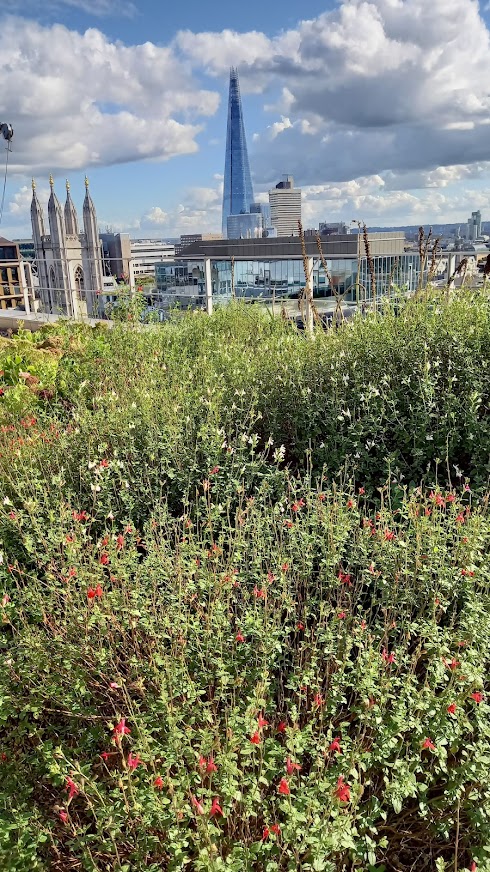
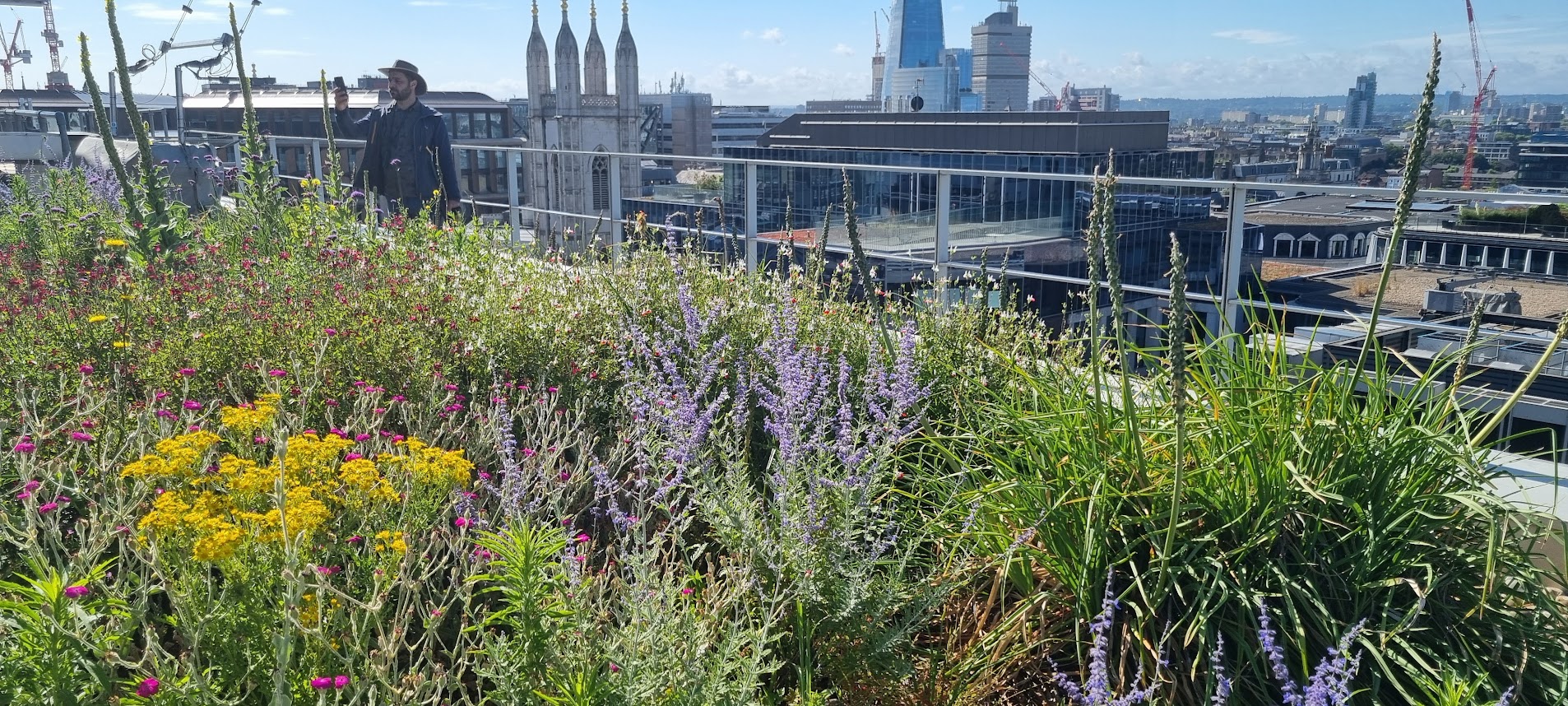
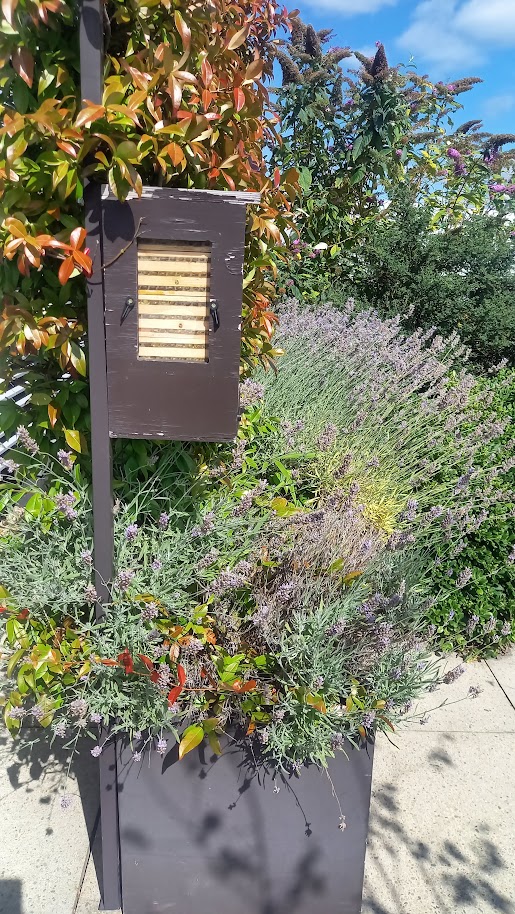
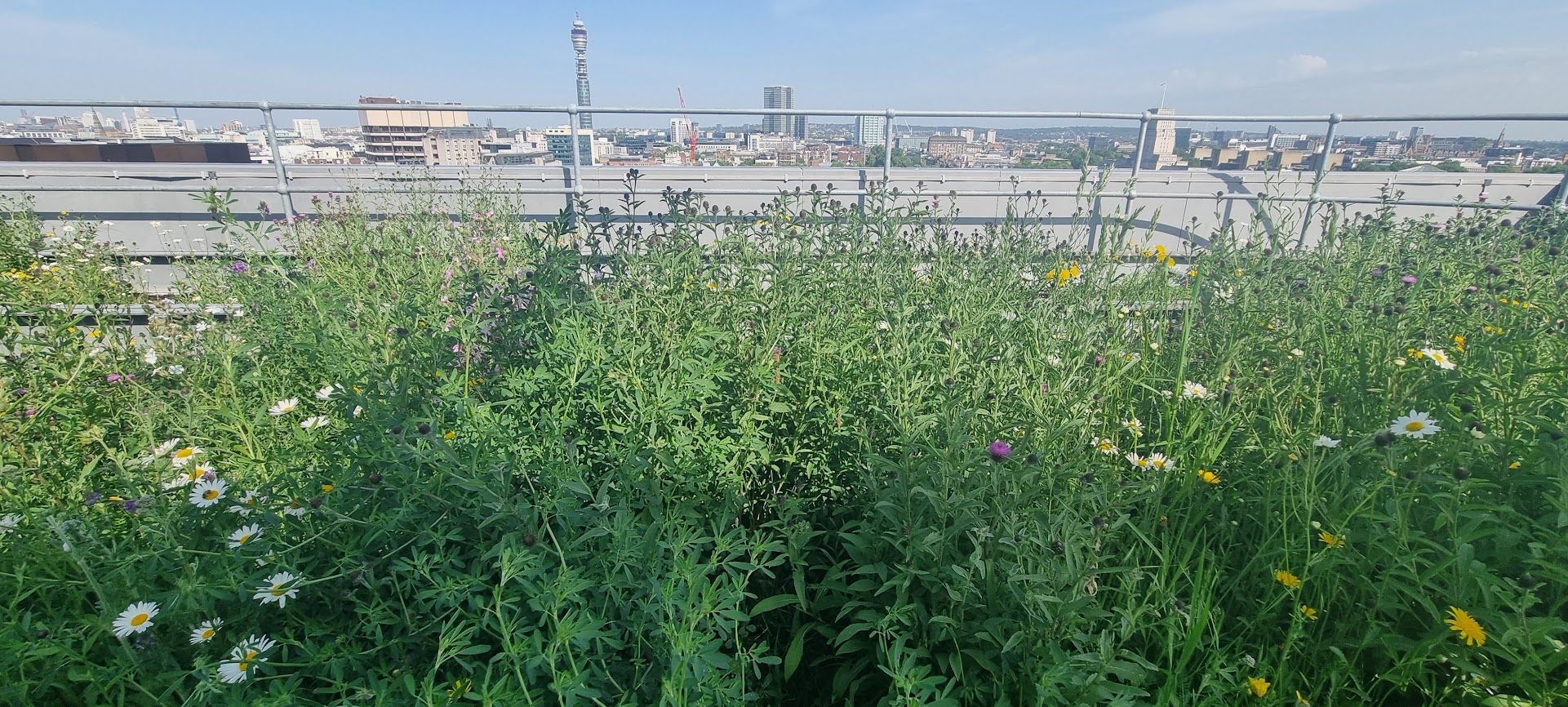
Bow Bells House, by St Paul’s, and Weil roof terrace in Fetter Lane both scored in the top 5 for rooftops providing good habitat for pollinators in the City of London in 2025.
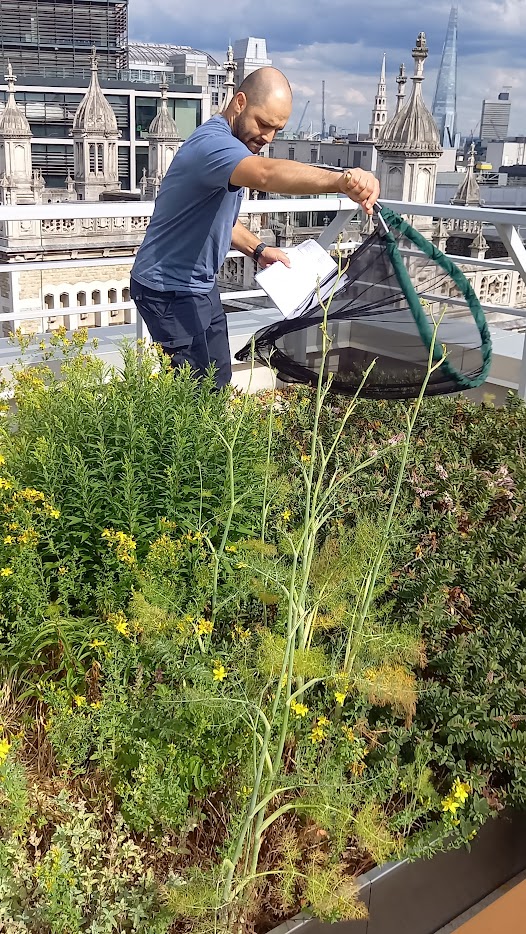
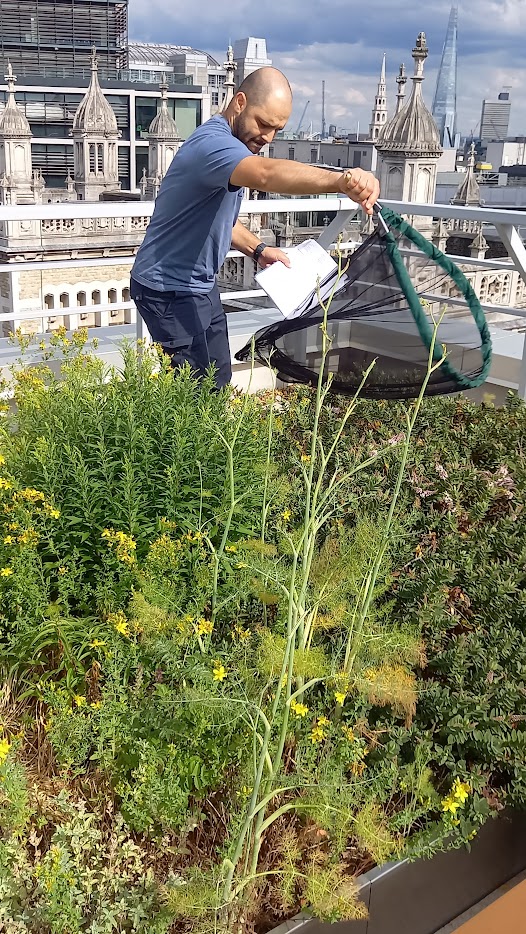
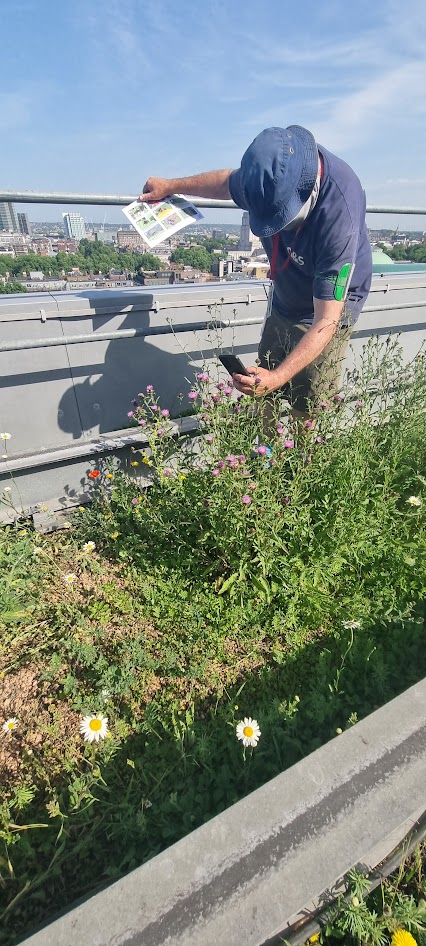
Both rooftops were surveyed each month during late spring and summer for pollinators by ecologist Dr Konstantinos Tsiolis (pictured above) for charity Pollinating London Together.
The criteriaand the score
Plants for pollinators; Bow Bells House (4/5) Weil (3/5)
Nesting for pollinators Bow Bells House (3/3) Weil (3/3)
Use of pesticides Bow Bells House (3/3) Weil (3/3)
Monitoring Bow Bells House (1/1) Weil (1/1)
Pollinator species/groups found Bow Bells House (6/8) Weil (6/8)
Final score Bow Bells House 8th floor roof planters 17/20 (pictured below)
and Weil Roof 8th floor terrace 16/20 (pictured below)
Bee species recorded:
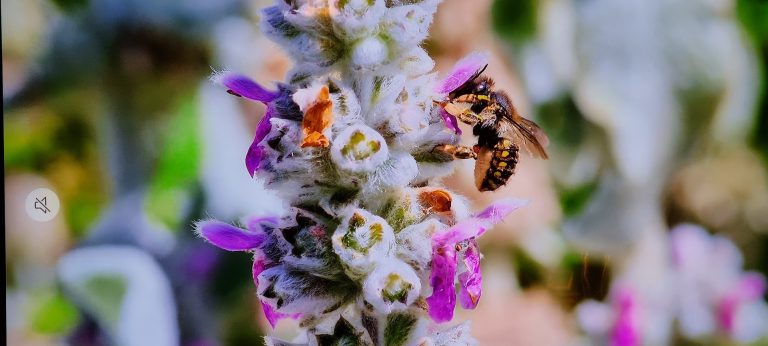
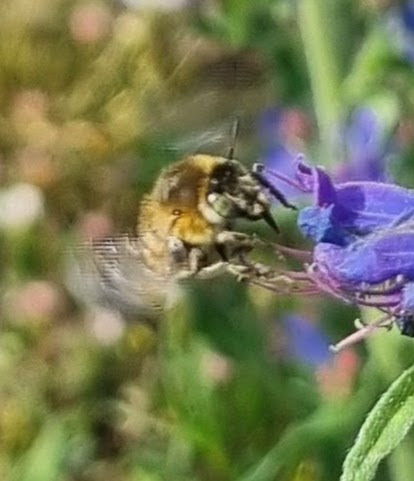
Bow Bells House – 4 bumblebee and 4 solitary bee species recorded including Wool carder bees (Anthidium manicatum) pictured below on Lamb’s ear and tiny Green furrow bees (Lasioglossum morio)
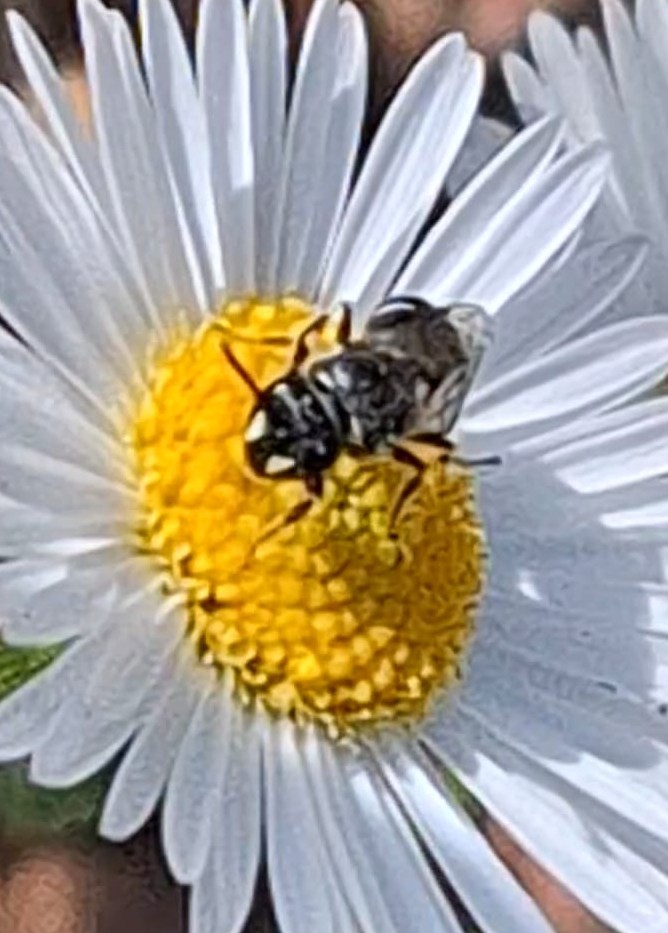
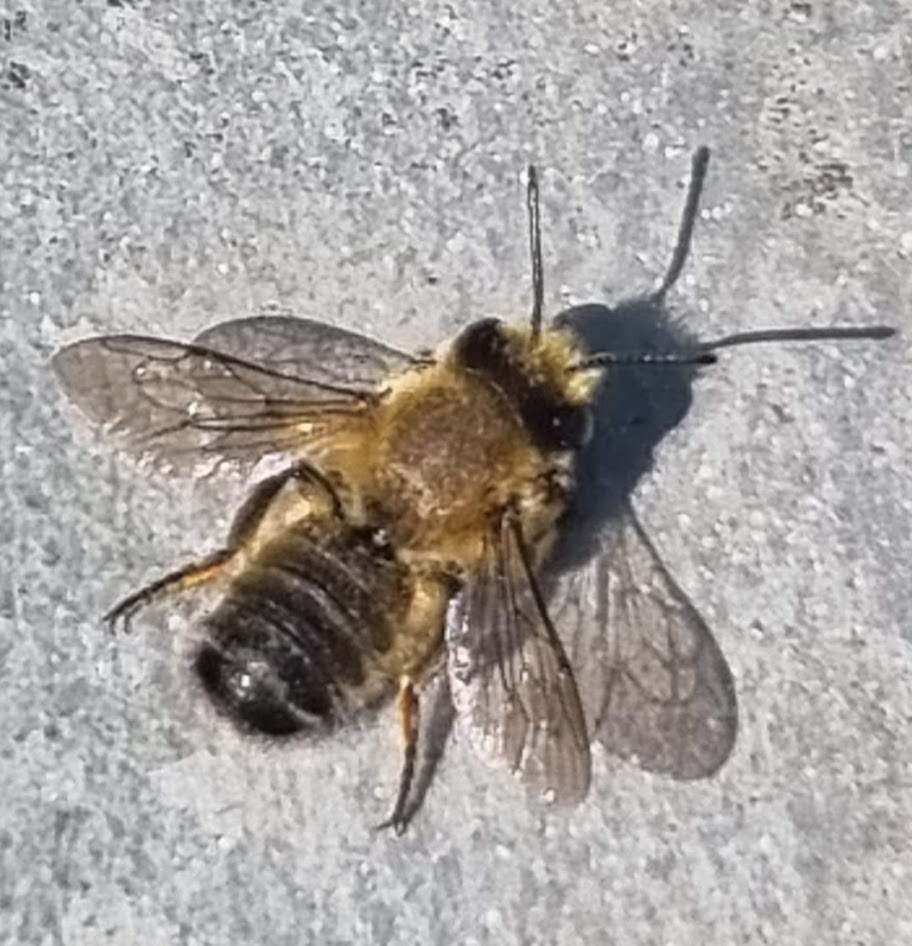
Weil terrace – 2 bumblebee species and 4 solitary bees species recorder, including Common Yellow-face bee (Hylaeus communis) (pictured below on another roof) and Hairy Yellow-face bee(Hylaeus hyalinatus).
Although in the top 5 of 10 city rooftops surveyed, Dr Tsiolis notes:
“These scoring sheets can only make very basic comparisons between sites. Factors such as size, height, nearby habitat and diversity and abundance of nesting resources are not considered. This year, I am combining data from the last three seasons and conducting a more in-depth analysis.”
Flowers – any green space, from a park to a garden, allotment, or cemetary. Anywhere where there are plenty of different bee-friendly flowers or shrubs in bloom
A dry, calm, warm day is best. It doesn’t have to be sunny, although that helps. If it’s over 27C, bumblebees may not forage, so best to do it early in the morning when it is cooler
A net and small glass tube if you are confident about catching small insects without hurting them and putting them in a tube for identification (something I haven’t mastered)
Bee Spotter’s Guide – an illustrated pocket book that may help you to identify a few bees.
Citizen Science
Do your ‘bee safari’ for Bumblebee Conservation Trust by becoming a Bee Walker and record bumblebees you see each month in the same area.
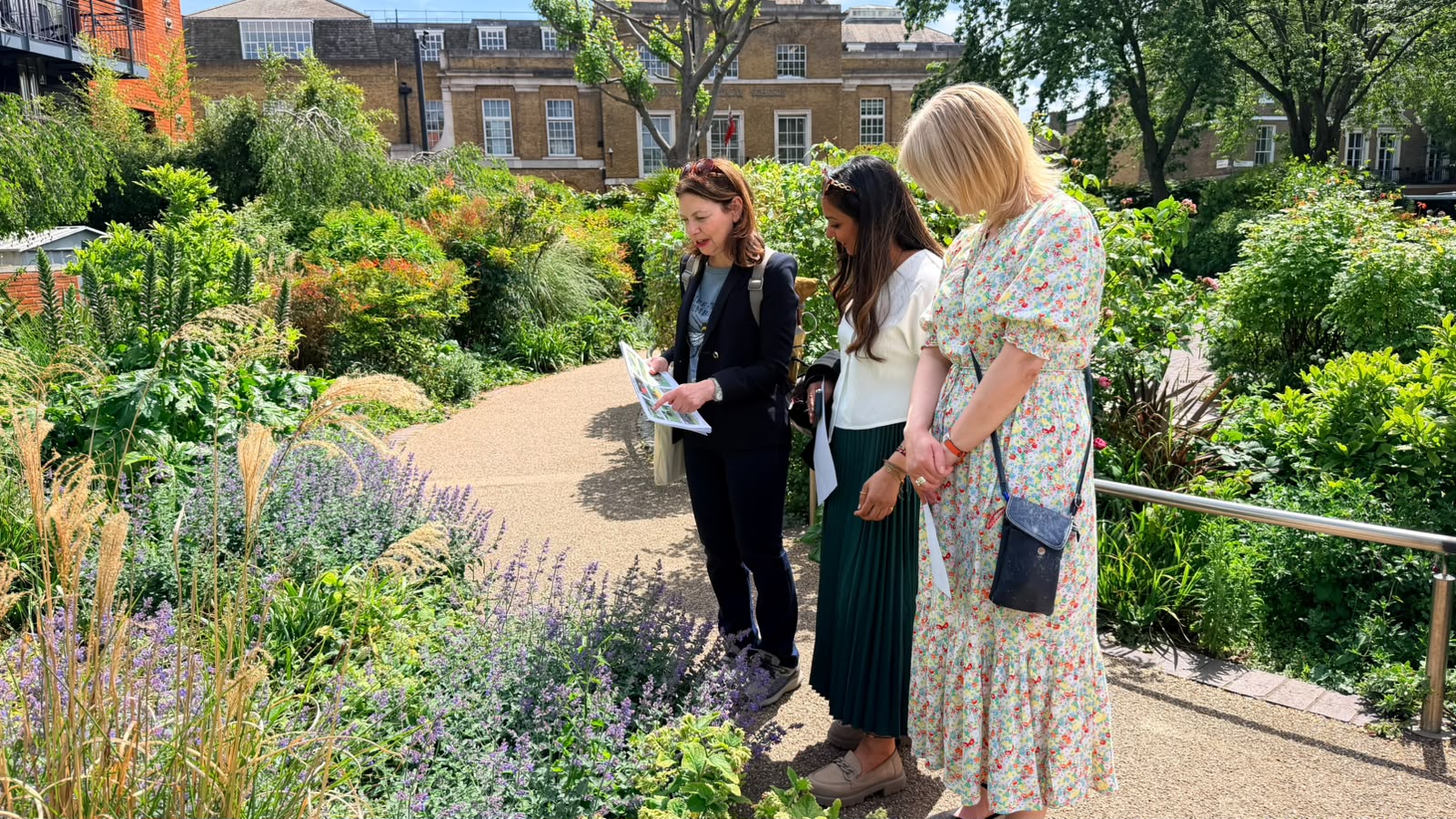
Urban Bees leads bee safaris for a number of clients’ staff including Boodle Hatfield (pictured above), Weil law firm, Price Waterhouse Coopers and the Friends’ of Regents Park.
To learn more about our bee safaris contact alison@urbanbees.co.uk
During an hour-long monitoring visit to the roof of a 12 storey building in Bloomsbury on 28 May, from 9.30- 10.30, with Ryan Mesarcik at Q&S Landscapes, we recorded 8 different bee species foraging:
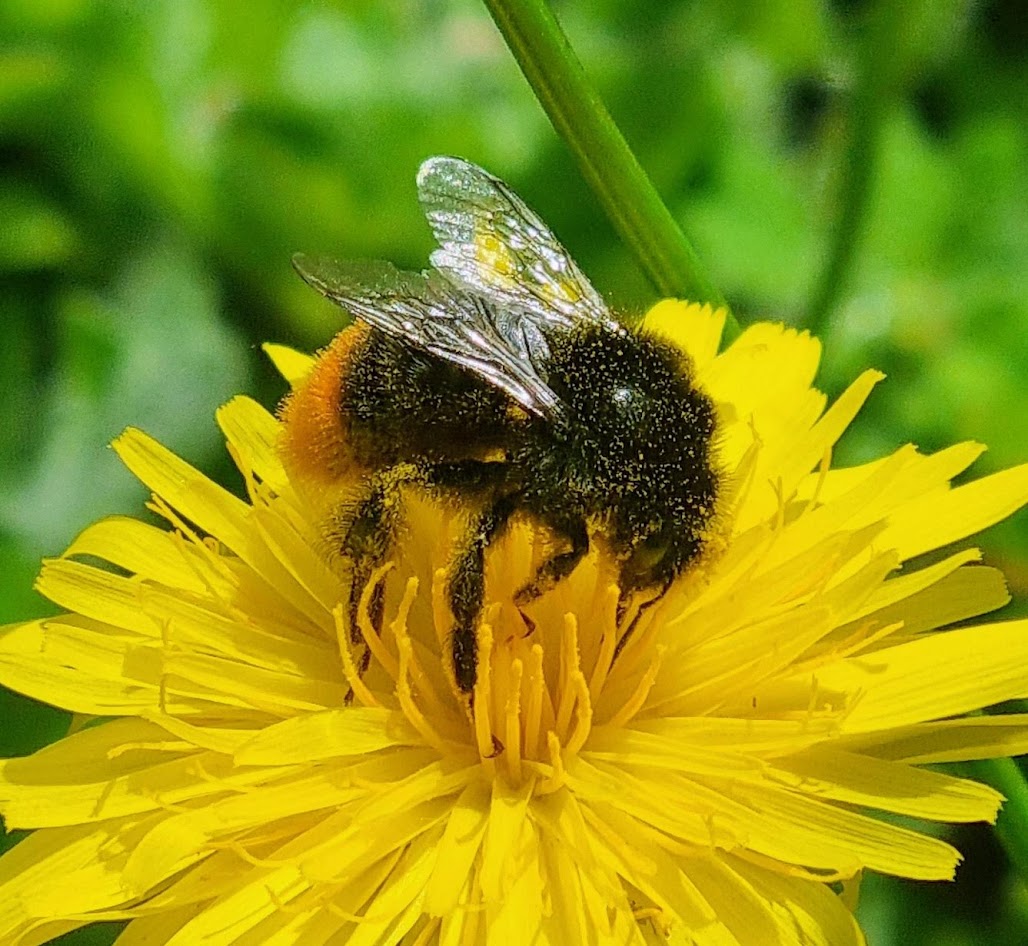
Many Red-tailed bumblebees (14-16mm) on Hawkbit (pictured), Knapweed and Vetch
One Leafcutter bee (9-10mm) (pictured) on Purple vetch
Six Four-banded flower bees (7-8mm) on Vipers bugloss (pictured)
A few Common furrow bees (8-10mm) on Mexican fleabane and Oxeye daisy.
A Yellow-face bee (4.5mm) on Mexican fleabane
A Blue mason bee (6-7mm) on Clover
Many Buff-tailed bumblebees (13-18mm) on: Hawkbit (Dandelion-like), Kidney vetch, Clover, Ragged robin, Vipers Bugloss, Oxeye daisy, Knapweed.
Many honeybees (9-10mm) on Hawkbit and Knapweed.
We used our eyes, our phones, and our bee charts to record and identify bees.
Urban Bees has been working with maintenance contractor, Q&S,the gardener designer and building manager, Savills to feed as many different bee species as possible throughout spring and summer on the huge roof.
It just goes to show with the right flowers – natives and non natives – and irrigation that wild bumblebees and small solitary bees will forage that high. We don’t know where any of them are nesting!
A June survey will follow at the end of the month…
This month, it’s always sad to no longer see Hairy-footed flower bees and Red mason bees, as their short life-cycles come to end. But we can say hello to some summer beauties, like the Wool carder bee and leafcutter bees. You’ll hopefully see three more bumblebee species too and a cuckoo bumblebee, (There will also be plenty of buff-tailed and white-tailed bumblebee workers foraging, and smaller, brown common carder bees. We haven’t included them in the June guide as we wanted to introduce you to some new faces). There are four new solitary bees to try to identify this month: a mason bee with an orange pollen brush under her abdonmen; a small, zippy flower bee with huge green eyes; leafcutter bees; and one of my favourties. the Wool Cardr bee. And see if you can spot the difference between a bumblebee and a hoverfly that mimics a bumblebee.
Tips for IDing June bumblebees:
Early bumblebee (Bombus pratorum) – if you see a small. pretty bumblebee (9 -13mm) with a faint red bottom and yellow stripes, it’s an early bumblebee. The male (pictured above) is particularly striking with his bright-yellow fluffy facial hairs and a stripe on his body too. This month, new queens may be emerging, along with workers and the males. Look out for them on cotoneasters, brambles, Raspberry and Crane’s-bill (hardy geraniums). They can also nectar rob from longer, tubular flowers. They have small colonies of up to 100 bees and generally nest underground in old rodent burrows like many bumblebee species, but they can also inhabit bird boxes (like Tree bumblebees (Bombus hypnourm) and nest in roof spaces and holes in trees.
Garden bumblebee (Bombus hortorum) – sit by a patch of flowering foxgloves or honeysuckle and you will hopefully see this long-tongue bumblebee coming in and out of the flowers. The way to identify most bumblebee is to look at the colour of their bottom, but this one has the same colour as a Buff-tailed and White-tailed bumblebee, so you have to examine the face. If it has a longer ‘horsey’ face then it’s a Garden bumblebee. The other tell-tell sign is if she is going into the flower rather than sucking up the nectar from the side. Many bumblebees with white tails have shorter tongues and so they nectar rob by making a hole in the base of the flower.
Red-tailed bumblebee (Bombus lapidarius) –unmissable with jet black bodies and fiery red tails, but records show that they are becoming less widespread. I have read that they favour yellow flowers, so I am planting lots of Birds-foot trefoil for them, but so far no luck in my London garden. But I have seen them this year on a rooftop foraging on yellow Hawkbit and purple Knapweed. I’d also suggest looking up at Laburnum trees drooping under the weight of yellow, pea-like flowers. In the photo above the female is putting up a leg as a warning signal that she feels threatened and to keep away. But these are gentle bees.
Vestal cuckoo bee (Bombus vestalis) – also called the Southern cuckoo bee because it used to be only in this part of England where you are most likely to see the huge females (24mm) seeking to invade the underground nest of Buff-tailed bumblebees (Bombus terrestris) and lay their eggs. Now they are more widespread. At this time of year only smaller Buff-tailed bumblebee workers are foraging. So if you see a huge bee that looks like a big Buff-tailed bumblebee queen, it’s more likely to be its cuckoo. Other ID tips: she has a longer white tail with yellow hairs at the base, and there are NO pollen baskets on her hind legs. (She is a female and not a queen because she doesn’t have worker bees. Her eggs hatch into females and males that are fed by the Buff-tailed bumblebees worker bees. These workers become the cuckoo bee’s slaves after she takes over their mother’s nest.) NOTE: There are 6 Cuckoo bumblebee species in the UK. This is the most common one because its host is the most common bumblebee.
How to ID June solitary bees:
Green-eyed flower bee (Anthophora bimaculata) – these gorgeous looking bees with their stunning big green eyes are around half the size (8mm) of the spring-flying Hairy-footed flower bees (Anthophora plumipes). Their diminutive size, along with their rapid darting movement between flowers, makes them much more difficult to spot and they are largely confined to southern England, especially coastal areas and heathland where they nest in large, noisy aggregations in sandy cliff tops and the edge of costal pathways. They feed on Vipers bugloss, Black horehound, brambles, Thyme and mints including Nepeta and other garden catmints. Listen out for the high-pitched buzz as they feed, often in groups. They fly until September, so one to watch out for if you’re holidaying on the South cost this summer.
The Orange-vented mason bee (Osmia leaiana) – has a fluffy orange pollen brush under her abdomen which she uses to collect pollen from a variety of flowers including Green Alkanet, Crane’s-bill (hardy geraniums), brambles and knapweeds. You may see her nesting in a bee hotel, or a bee observation box. Here is a video of her packing her nest with pollen (we mistakenly called her a Blue mason bee because they fly at similar times of the year and both use masticated leaf to plug the tubes of their nest).
Patchwork leafcutters (Megachile cenuncularis) are one of the most common leafcutter bees found in gardens. They get their name, like many solitary bees, from how they construct their nests. They cut pieces of leaf from many plants including rose and lilac bushes, honeysuckles, willowherbs, Amelanchier trees, birches and Horse chestnut to make their nests, leaving the leaves looking as if they has been attacked by a hole punch. This leafcutter bee is a little smaller (9-10mm) than a honeybee and a brownish grey colour. But the easier way to tell her apart from a honeybee is from the orange pollen brush on the whole underside of her tummy, (similar to the Orange-vented mason bee), which she has a habit of lifting up in the air while feeding on flowers. Favourites include thistles, knapweeds, burdock, Common Fleabane, Bird’s-foot trefoil, St John’s-wort and brambles. They nest in bee hotels if Red mason bees have left any tubes unoccupied. They plug the entrance with pieces of leaf later in the summer when they have laid all their eggs in a tube. If you’re very lucky, you may see a female flying with a piece of leaf as big as herself clasped between her legs. They can also nest in dead wood, cavities in walls and even occasionally in soil. TOP TIP: How to tell a Orange-vented mason bee from a leafcutter – with difficultly, but the mason bee is a fraction smaller (8mm), but has a bigger head and narrower body and uses chewed up leaf to construct her nest, rather than discs of leaves.
The Wool Carder Bee (Anthidium manicatum) is an easy bee to spot and therefore one of my favourites. It’s a chunky 16mm bee with yellow spots that looks like stitching along the side of its abdomen . And if you plant Lamb’s Ear (Stachys byzantina), you are guaranteed to see females collecting the soft downy material from the underside of the leaves to line and plug their nests. Carder means to ‘tease out fibres’, and the female rolls the hairs into a ball as big as herself to carry home to her nest which is in a ready-made hole in dead wood, cavities in wall and man-made objects. I’ve yet to see one. You may also see the larger male bees aggressively defending their patch of purple flowers for mating by attacking intruders mid air. They are armed with spikes under their abdomen that can kill their foes. As well as Lamb’s ear, these bees can often be seen feeding or mating around Black horehound, Purple toadflax and vetches. NOTE: Despite having a similar English name to the Common carder bee (Bombus pascuorum), they are very different. The latter is a social bumblebee.
Bee mimic
Bumblebee hoverfly (Merodon equestris) – some hoverflies are excellent bumblebee mimics with their fluffy coats and round bodies. TOP TIP: The way to tell them apart from real bumblebees is the eyes (flies have bigger eyes), the legs (flies have spindly legs and they don’t collect pollen on their back legs), and they tend to stay still on a flower or leaf for longer than a bee with their wings out, rather than tucked behind them.
How to help bees in June:
Planting different flowers for different bees is particularly important this month when there can often be what’s called a June gap in the UK – a lull in nectar and pollen supplies as the horse chestnut trees finish flowering and trees, such as the limes, have yet to begin while spring flowers fade before summer ones burst into bloom. Try cotoneaster and thistles for short-tongued bees, and foxgloves, honeysuckle, comfrey and catmint for longer-tongued bees like the Green-eyed flower bee. Research by bee-friendly plant supplier, Rosybee found that in June the yellow flowers of Dyer’s chamomile (Anthemis tinctoria) were the best for all types of solitary bees, followed by purple Geranium rozanne ( a favourite in my small garden because it flowers until October). Biennial Viper’s bugloss (Echium vulgare) was best for bumblebees, as it produces nectar all day long, followed by catmint (Nepta racemosa – another long flowerer) and a white lavender (Lavandula x intermedia ‘Edelweiss’). Don’t forget Lamb’s Ear (Stachys byzantina) for the Wool carder bees.
If you only have a window box, try growing Scabious japonica, dwarf harebells (Campanula carpatica), dwarf lavenders, Mexican fleabane (Erigeron karvinskianus), seaside daisy (Erigeron glaucus), and creeping thyme (Thymus serpyllum) which flower from June onwards. Water regularly.
Don’t pull up weeds like Alkanet, which feed many types of bees, and continue not to mow part of the lawn (after No Mow May comes Let it Bloom June ) to let clovers and knapweeds grow.
It’s not too late to install blue tit boxes – not for birds but for Tree bumblebees (Bombus hypnorum) and possibly Early bumblebees to nest in. They will vacate at the end of the summer, so you may get blue tits nesting next spring.
Put up bee hotels. It may be too late for Red mason bees, but Orange-vented mason bees, Blue mason bees and leafcutter bees may check-in and lay their eggs this summer. Leafcutter bees prefer slightly bigger diameter tubes of 9-10mm. The others 6-8mm. We have created flat-pack bee hotels that can be easily assembled and come with instructions about where to put them and how to attract bees to nest in them by planting their favourite flowers.
Create your own nests for cavity-nesting solitary bees, by drilling holes in blocks of wood – 10mm, 8mm, 6mm and 4mm diameters and up to 30 cm deep – and screw them to a sturdy support. Drill holes in existing structures such as fence posts, or dead trees. See which bees take up residence over the summer.
Continue to leave bare earth for mining bees to burrow into, or if you have space make a 1m 2 sand mound for mining bees to nest in. See here for a step by step guide.
Provide a source of water for thirsty honeybees. This can be a shallow bowl or saucer with stones or pebbles in that the bees can stand on while they are drinking. Bees can’t swim!
Ditch the weed killers and pesticides – that includes all bugsprays for your roses!
Where have the spring-flying solitary bees gone? The Hairy-footed flower bees (Anthophora plumipes) are disappearing, along with Red mason bees (Osmia bicornis) and early mining bees. This is because adult solitary bees only live for a few weeks (6-8 weeks). And the spring flying solitary bees that came out in April or before have now reproduced and provisioned their nests with pollen, so their life cycle has come to an end. In their short life they mate and then the female makes, or finds and adapts a nest in which to lay her eggs. She forages for pollen to leave in the nest for the hungry larvae which will hatch from her eggs and gobble up all the pollen. But she will never see her offspring. When she has laid all her eggs and provisioned them with pollen, she will plug up the entrance to the nest, and exhausted from all her activities she will die on the wing. But in her short life she has done an extremely important job – pollinated many flowers, shrubs and trees whose fruits, seeds and nuts are food for birds and other species. Once the larvae have eaten all the pollen, they spin a cocoon, pupate and transform into adult bees through metamorphosis. They overwinter in the cocoon and will emerge next spring to start the life cycle again. The males of all solitary bee species emerge first to build up their strength for mating. In the case of the Red mason bees, they break though the mud at the end of the tubes in the bee hotels.
This month, hopefully you will see at least one new bumblebee species, a new mason bee, four types of mining bee, the now familiar Hairy-footed flower bee, and two ‘cuckoo’ bees – the Mourning bee and the Vestal cuckoo bee. (All photos credit: Penny Metal)
You will continue to see some of the bumblebees you first spotted in March and April, but instead of queens you will now probably be seeing the smaller worker bees foraging on flowering trees and plants.
How to ID May bumblebees:
Tree bumblebees(Bombus hypnorum) with their ginger thorax, black body and white tail could be the new occupants of your blue tit box if the chicks have fledged. I’ve not seen them in London for a few years now, so it appears you’re more likely to see them in cooler parts of the country. Be prepared for noisy buzzing outside their new home as gangs of males compete to mate with virgin queens. (As you can see from the photo, the male on top is much smaller than the queen.) Tree bumblebee colonies vacant a bird box at the end of the summer, so it will be empty for the blue tit family next spring.
Top ID tip to tell a Common carder bee from a Tree bumblebee – both sport a bright ginger pile at this time of year (later in the year, the former fades and the latter goes a bit bald), so the best way to tell them apart now is to focus on getting a look at their bottom. The Tree bumblebee has a tiny white bottom and a darker body (abdomen). The Common carder bee is brown all over. Good luck!
Bumblebee cuckoo bee
Vestal cuckoo bee (Bombus vestalis) – also known as Southern cuckoo bee because she used to be more common in the south of England – looks very similar to a Buff-tailed bumblebee (Bombus terrestris). That’s because she resembles the bee whose nest she takes over. Like the cuckoo bird (hence the name), she lays her eggs in the nest already made by her host. The cuckoo bee will actually kill the host queen and her eggs and dupe the host’s worker bees into raising the cuckoo bee’s young. Cuckoo bees are either male or fertile females. They do not have queens or worker bees..
There aresix cuckoo bumblebees in the UK. Because Buff-tailed bumblebees are so common, so too is the Vestal cuckoo bee. Their presence means the host population is healthy.
Top tip for telling a Vestal cuckoo bee from a Buff-tailed bumblebee – The easiest way to tell these two large bumblebees apart is that the cuckoo has a longer white tail and above the tail is a pale yellow band. It’s a paler yellow than the dirty gold on the bee’s thorax and paler than the Buff-tailed bumblebee’s golden bands. The Vestal cuckoo female is a similar size to a Buff-tailed bumblebee queen but much bigger than Buff-tailed workers. Their wings may seem a bit darker and the other tell-tale is that they never carry pollen (as the host workers will feed its young). This is true for all cuckoo bumblebees.
How to help bumblebees in May:
Leave a patch of the garden wild for nesting sites and don’t disturb a nesting site if you find one for example in a compost bin or under a garden shed (it will only last until the end of the summer). Leave some permanent long grass in which Common carder bees may nest.
It’s not too late to put up a blue tit box for the tree bumblebee to nest in. Again, they will leave at the end of the summer and birds can use it next spring.
Buy and plant alliums, catmint and cotoneaster from garden centres to provide food this month for short-tongued bumblebees. Foxgloves, honeysuckles and thistles for the long tongued bumblebees.
It’s not too late to grow from seed annuals that provide late summer bee forage such as sunflowers, cosmos and Anise hyssop.
Scatter wildflower seeds or seed balls in pots or on bare earth. The annuals will flower later in the summer and perennials next year.
How to ID May solitary bees:
Grey-patched mining bee (Andrena nitida) is one of the most common mining bees in southern Britain, extending up to Lancashire and Yorkshire. She has a brighter red, fluffy pile on her thorax than the short-fringed mining bee, and grey patches on her black abdomen. These medium-sized bees (10-12mm) can be found foraging on spring blossoming shrubs and trees and dandelions and in scattered nests in flat or sloping turf and lawns.
Top tip for finding a Grey-patched mining bee – find it’s more striking waspish-looking Nomad bee, (another name for a cuckoo), Flavous nomad bee (Nomada flava). You can see them on the ground searching out a Grey-patched mining bees’ nest to take over, and then you may spot the host bee herself.
The short-fringed mining bee (Andrena dorsata) is widespread too in southern England. Sporting a reddish-brown fluffy pile on her thorax, a smooth black body with thin stripes, and a very hairy dorsal fringe on the top of her back leg, the female should hopefully be easier to identify on dandelions and daisies than some of the other small, brown mining bees also around at this time of year.
Hairy-footed flower bees (Anthophora plumipes) have been flying for a couple of months now so you are probably becoming accustomed to seeing them darting noisily around patches of comfrey and wallflowers with their tongues outstretched. Many of the black females will have mated and are now busy collecting pollen on their hairy hind legs for their young.
Ashy mining bees (Andrena cineraria) A distinctive black and grey stripped bee (around 11-14mm), which nests in bare ground, footpaths and tracks. Although solitary, they nest next door to each other in dense aggregations, so hundreds can emerge at the same time. But don’t worry, solitary bees don’t sting and are short-lived (around 2 months)!
The Mourning bee(Melecta albifrons) is another black and grey bee. Her coat is a fluffy grey/black colour, edged with lateral white spots. Despite her cute appearance, these are the Hairy-footed flower bees’ cuckoo. The female lays her eggs in the already made nest and when her larvae hatch they steal the pollen collected by the Hairy-footed flower bee. A quarter of the 20,000 plus bee species on the planet are cuckoos.
Top tip for telling a Mourning bee from an Ashy mining bee – the former is rounder and fluffier, like its host bee, and also has lateral whitish spots down its body. The Ashy mining bee has a longer, smoother black body and is often found near to the ground nesting in large aggregations.
Common mini-miner (Andrena minutula). If you see a tiny mining bee (4-5mm) at this time of year, chances are it will be this mini-miner bee because as its name suggests it’s the most common of the 10 species of mini-miners in the UK. They have a hairy fringe along the thorax and markings on their head if you can get that close. They are most visible on dandelion type flowers and sallow (willows). They nest in loose soil in large groups.
Blue mason bee (Osmia caerulescens) – bit smaller than the more common Red mason bees, the males, which are flying now, have a fluffy brown pile of hair over a dark metallic-coloured body. The females look blueish-black with a box-shaped head. They will nest in manmade bee hotels, but construct the cells and plug the tubes with chewed pieces of leaf. You may see them on a variety of flowers in an urban garden. The females come out a week or so after the males and they are around until July.
How to help solitary bees in May:
Plant wallflowers and comfrey for long-tongued Hairy-footed flower bees. Flowering fruit trees, willows, spurges, alkanet and forget-me-nots and geraniums for Red mason bees, and mining bees.
Leave old mortar untouched as Hairy-footed flower bees and Red mason bees may be nesting here.
Leave a patch of bare earth for mining bees to burrow.
Leave a patch of bare, wet earth for Red mason bees to collect mud to make partition walls in the tubes where they are nesting and to plug the end of the tubes.
Don’t mow the lawn to let dandelions and clovers grow. Small, brown mining bees are easiest to see on bright yellow dandelions. I now let dandelions grow in my herbaceous perennial flower borders to spot these bees.
In July 2025, I invited National Geographic filmmaker, Bertie Gregory, to the rooftop garden I created and maintain for wild bees on Bow Bells House. He was looking for a central London location to film bees for his Secrets of the Beesdocumentary. Three years in the making, and shot around the world, he wanted to include a short section on bees in cities.
For those of you who don’t subscribe to National Geographic TV or Disney+, I wanted to share what Bertie found.
He was shocked at the sheer number of honeybees he saw on a garden I designed for wild bees. “Honeybees aren’t wild, they are more akin to livestock”, he says.
2. ‘In a corner of a patch of flowers, I have found a magical kingdom. Its king is a male Wool Carder bee”
He found Wool Carder bees on the swathes of Lamb’s ear (Stachys byzantina) I had planted especially for them because the females collect the soft fibres from the leaves to line their nest.
3. “It’s amazing how much drama and action there is just in this little patch” – he films the male Wool Carder bee fighting off many honeybees and a Buff-tailed bumblebee.
4. Territorial males defend a patch from any bee and wait for a female to appear. Finally she arrives….and he pounces and quickly mates. Bertie thinks the male must be exhausted from all this fighting.
5. “It used to be thought that to save the bees you should put in lots of hives, but in reality what you’re doing is just introducing more competition”, he says showing hives on an nearby office rootop in London.
6. “What’s important is to give wild bee species enough space and food to thrive” and he points to the Bow Bells House rooftop by way of example.
(These photos are all taken by me from the TV screen when I was watching the documentary).
It wasn’t Bertie alone who filmed the section. Silverback Films were up on the roof too. I had met them a week earlier when they had come for a recce of the site. The director, camerman, boom operator and researcher, Tom, who had first contacted me. Thanks guys…
Pictured above are the six most common solitary bee species this month: , Tawny mining bee, Buffish mining bee, Red mason bee, Orange-tailed mining bee (female pictured), Gooden’s nomad, Hawthorn mining bee, and Hairy-footed flower bees (female pictured),
How to ID these solitary bees:
The Tawny mining bee(Andrena fulva ) is easy to spot as she burrows up through lawns, her foxy-coloured coat strikingly visible against the green grass. And she leaves a tiny volcano-looking mound of soil in her wake. Like all mining bees, many will emerge from the same burrow or next door burrows in large aggregations.
The Buffish mining bee (Andrena nigroaenea) is around 10mm -13mm with a dense brown pile on the top of its thorax (just below it’s head) a bit like a mane. Look at the flowers on blossoming trees and shrubs such as fruit trees, willows, and blackthorn, and wildflowers like dandelions, hawk’s-beards, buttercups and spurges.
Red mason bees (Osmia bicornis) are checking out of bee hotels any day now by chewing through the mud-plugged tubes. They are a little smaller (7-10mm) than a honey bee (9-10mm), more gingery and have a rounder bottom. The males appear a week or so before the females and they congregate around the bee hotels waiting to pounce when the females emerge. The males sport a white moustache-like hair ontheir face, have long antennae and are slimmer than the females.
Orange-tailed mining bee (Andrena haemorrhoa) males emerged last month and now the more striking, larger females (11-13mm) are emerging. They are easier to spot because of the neat brick-red pile on their thorax and the tiny orange tip on their bottom. Try looking for them foraging on fruit tree blossom, dandelions and spurge. They will fly until July so don’t give up if you don’t see them this month. Like all mining bees, they burrow into the ground to nest, and they collect pollen on the hairs on their hind legs.
Gooden’s nomad bee (Nomada goodenianna) looks more like a common wasp, than a bee, It is actually a cleptoparasite, or cuckoo bee – meaning it doesn’t make it’s own nest, but as its name suggests roams around looking for the nest of its host, which is the Grey-patched (Andrena nitida) or Buffish mining bees(Andrena nigroaenea). As both these host bees can be difficult to ID becasue they are small, brown mining bees, look out for their nomad bee instead. If you see Gooden’s nomad bees, you can get a positive ID on their host. NOTE: There are 34 Nomada species in the UK (850 worldwide), and this is one of the most common. They break into the host’s underground burrows and lay their eggs. Their larvae kill the host larvae and eat the pollen. But healthy Nomad populations mean their hosts are alive and healthy. (Worldwide, a quarter of the 20,000 recorded bee species are cuckoos). TIP How do you to tell a Gooden’s and a wasp apart? Gooden’s are usually flying low looking for the nest of a mining bee or even walking around on the ground. And they won’t bother you.
Hawthorn mining bee (Andrena chrysosceles) is another small (9-11mm), cute brown mining bee not easily distinguishable from many others! It has orangey coloured hind legs, a shiny blackish, striped abdomen and a brown, hairy thorax, Despite its common name, it feeds on a lot more than hawthorn blossom – dandelions, blackthorn, buttercups and spring-flowering shrubs.
Hairy-footed flower bees (Anthophora plumipes) are often mistaken for bumblebees because of their round, fluffy appearance, but they live alone (not in colonies). At this time of year, the striking black females are being pursued by brown-coloured males among the lungwort (pulmonaria), comfrey, wallflowers and alkanet with their long, straw-like tongues (proboscis) outstretched. It is mating season.
TIP FOR IDING LITTLE BROWN BEES: If you see a bee that at first you may think is a honeybee, take a closer look. If it is a smaller. slimmer and browner, chances are it’s one of the many brown mining bees out at this time, of which the Buffish (Andrena nigroaenea) is one of the most common, along with Gwynne’s (Andrena bicolor) and the Short-fringed (Andrena dorsata) mining bee. Don’t worry if you can’t ID them, the fact that you are looking closely is good. The latter two have two generations in one season, so if you don’t spot them in the spring, you may see the next lot in late summer instead.
How to help solitary bees:
Plant lungwort, wallflowers, comfrey and flowering currants for long-tongued Hairy footed flower bees. Flowering fruit trees, willows, spurges, wallflowers, Rosemary, alkanet and forget-me-nots for mining bees and Red mason bees.
Leave old mortar untouched as Hairy-footed flower bees may be nesting here. Or make some cob bricks that they can nest in instead.
Install bee-hotels in a warm location at least a metre off the ground, ideally facing south, or east, where Red mason bees can check-in and lay their eggs this month and next. We’ve made our own bee hotels that we fill with either 15cm deep cardboard tubes or bamboo. The cardboard tubes can be removed in the winter and put in a cool, dry shed to protect them from the elements and the bee hotel can be cleaned and new tubes installed.
Leave a patch of loose, bare earth for mining bees to burrow and where Red mason bees can collect soil to plug their nests.
Create a bank of sand or a mound of sand in a sunny spot for mining bees to nest in.
Let dandelions and alkanet grow – they are very important early bee food. Research shows there is a hungry gap for bee in March-April, so these good sources of nectar and pollen are more vital than ever.
Don’t mow the lawn – let dandelions grow.
Bumblebees
Pictured above are two bumblebee species you’re likely to see this month: Early and Red-tailed bumblebees. (In addition you may also see Buff-tailed bumblebees (Bombus terrestris) which have been flying all year in some southern parts of the UK, Common carder bees (Bombus pascuorum) which are just emerging, and Tree bumblebees (Bombus hypnorum).
How to ID these bumblebees:
The Early bumblebee (Bombus pratorum) is smaller than other bumblebee species (up to 13mm) and prettier with her fluffy yellow collar and her noticeable orangey bottom. As her English name suggests, this is a spring specialist. Not only does the queen fly early in the year, but she creates her colony of workers and males earlier than most other bumblebee species. So this month, you may see female workers and even males. You can tell them apart because the males have much more yellow facial hair, like the one above.
The huge, 22mm Red-tailed bumblebee (Bombus lapidarius) queens are one of our biggest bumblebees and without doubt one of the most striking with their black body and fiery red bottom. Although widespread, I’ve not seen one for a long time. The books say she is partial to blossom of sallow (willow) and prunus (cherries and plum) trees. Research by Bumblebee Conservation Trust, shows that there has been a marked decline in this bee species over the last decade.
Queen bumblebees may have nested (most underground in old rodent holes, under paving slabs, garden sheds, or even in compost bins) by now and laid their eggs, and some, like the Early bumblebee, may even have produced worker bees who are out collecting nectar and pollen to take home to their queen and her developing colony. Now is a crucial month to help them collect sufficient pollen to feed the larvae in the nest that will develop into new workers. We can help best by planting pollen-rich spring flowers.
How to help bumblebees:
Leave a patch of the garden wild for nesting sites and don’t disturb a nesting site if you find one (it will only last until the end of the summer).
Put up a blue tit box for Tree bumblebees to nest in after the chicks have fledged.
Plant dead-nettles, clover, forget- me-nots, rosemary, wallflowers and more to provide food this month for the short-tongued and long-tongued bumblebees.
Sow seeds inside now to create more flowers later in the summer. Sweet peas, sunflowers, cosmos and Anise hyssop are some of the easiest to grow. Try growing on a heated mat until the seeds germinate.
Don’t mow the lawn (let clovers and dandelions flower) and ditch the weed killers and pesticides.
It’s still cold in the mornings and when the sun goes in, so bumblebees can get chilled and easily exhausted. The best way to help is to put them on a flower, or give them a teaspoon of sugar, water solution, or carry a Bee Revival Kit on a keyring. But they can rest for 45 minutes. So give them time. But please don’t feed them honey, it harbours bacteria that is bad for them.
For information on the honey bee (Apis mellifera) and the bee-fly(Bombylius major) see Bees to See in March blog here.
If you’re new to bee spotting, March is a good month to begin If you’ve been waiting all winter to get back to bee spotting, now’s the month to resume on dry, warm, sunny days.
In March, the queens of two commonbumblebee species are emerging from hibernation:
The Early bumblebee (Bombus pratorum) queen is small for a bumblebee (13mm), with yellow and black stripes and a distinctive orangey bottom. By the end of the month her brood may have developed into adult, worker bees and will be out foraging instead of the queen. They are a smaller version of the queen. At just 9mm, they are the smallest bumblebee you will see. They get their name because the colony is the earliest to develop, with males flying by May
Common carder bumblebee (Bombus pascuorum) queens start to make nests in March, and her colony can go on well into October. She is easily recognisable from her fluffy, gingery thorax and brown bottom. Queens are around 13mm. The slightly smaller workers look identical.
(Other common bumblebees flying now are the very large, stripy Buff-tailed bumblebee (Bombus terrestris), whose colonies have been active throughout the winter in many parts of the UK, and the tri-coloured Tree bumblebee (Bombus hypnorum) queen with a gingery thorax, black body and white bottom.)
Queen bumblebees are either looking for a place to nest (most nest underground in old rodent holes, which is why you may see them flying close to the ground, but Common carder bees prefer tussocks of long grass and mossy areas, and Tree bumblebee nest high in tree trunk or bird boxes), or they have just found a good location and laid some their eggs, and are out collecting nectar and pollen to take home to feed their developing colony of workers.
The males of six common species of solitary bees emerge:
Hairy-footed flower bees (Anthophora plumipes) are often mistaken for bumblebees because of their round, fluffy appearance, but they live alone (not in colonies). The brown, male hairy-footed flower bees emerge a few weeks before the females. They visit Red dead-nettles, Grape hyacinths, Lungwort and other flowers with bell-shaped flowers sucking up the nectar with their long, straw-like tongues (proboscis) to build up their energy for mating when the females appear. If you plant these flowers they will come and are highly entertaining to observe zig zagging and darting around patches of these flowers emitting a loud, high ptiched buzz.
Buffish mining bees (Andrena nigroaenea) – are easier to spot than some other similarly dark coloured mining bees, because of their size (about the same as a honeybee (10-11mm) and most importantly the luscious. mane of brown/gingery hair around their black thorax. The males emerge first and are more brown in colour, the females have more black hairs. They are one of the most common mining bees in southern England and in urban areas on blossoming fruit trees, shrubs and dandelions.
Red mason bees(Osmia bicornis) – the males can emerge toward the end of the month if it’s warm to feed on blossoming fruit trees and shrubs. If you have a bee hotel you may see these cavity nesting bees checking out of the mud-plugged tubes when the crab apples are blossoming. They are a little smaller (12mm) than a honey bee (14mm), gingery coloured and have a rounder bottom. The males have long antennae and a pale moustache.
Orange-tailed mining bee (Andrena haemorrhoa) – also known as the early mining bee is 7-9.5mm. The males are brown with a dull brown fluffy thorax and tiny orange hairs at the tip of their bottom. You may see them emerging from holes in garden lawns, parks, playing fields – anywhere with light soil in a sunny spot. Like many mining bees, although they are solitary bees that nest alone, they nest next door to each other, so you may see hundreds emerging at the same time. But don’t worry, solitary bees don’t sting! You may see the males on dandelions, blackthorn, willows and gorse. The females are much more striking with their rusty-red pile of hair on their thorax, but you’ll have to wait until next month to see them.
Gwynne’s mining bee(Andrena bicolor) is a bit harder to spot, being 6-8mm, but look down and you may see them burrowing through soil on south-facing banks. The males are small (6-7.5m) and black, while the female (pictured above), which may not be out until next month, have a reddish-brown pile on the top of their thorax and hairy pollen brushes on the back legs.
Common mini-miner (Andrena minutula) – as its name suggests is a diminutive mining bee and the most common one in lowland Britain. At only 4-5mm, it will be hard to spot, but try observing dandelions in spring and if you see a tiny, black bee with paler, yellowish hair around its face and thorax you could be a mini-miner.
How to tell a male Andrena bicolor apart from an Andrena haemorrhoa?
With difficulty! Andrena bicolor males are darker (black in colour), smaller (6-7.5m) and less hairy. Andrena haemorrhoa males are brown, a little bigger (up to 9.5m), and bit fluffier on the thorax, and of course the tip of their bottom is orange, hence their common name. They forage on the same blossoming trees, flowering shrubs and spring flowers such as wood anemone, dandelions, lesser celandine, and even daffodils, and bluebells later in spring. And they nest in very similar locations. So, good luck (FYI haemorrhoa is pronounced He/more/rower.)
Why are only the male solitary bees around this month?
The males emerge earlier than the females because they need to build up their strength for mating when they girls appear. They will seek out sources of nectar to give them energy, patches of flowers which could make good mating grounds, and will often buzz around nests waiting for the ladies to check-out.
Bee mimic:
Many people confuse the Dark-edged bee-fly(Bombylius major) for a bee (which is why we’ve included it). Not surprising, because it’s a great mimic – round and fluffy like a small bumblebee. It’s very visible in the spring, hovering around green alkanet. The easiest way to tell it apart from a bee is its long, spindly legs, hovering action, and two wings (bees have four wings) which stick out at a 45c angle.
Honeybees?
We’ve not included honeybees in our Bees to See in March guide because they are managed bees, and we are focusing on identifying and helping wild bees. But you will see honey bee (Apis mellifera) workers (10mm) this month for sure because they leave the hive when temperatures reach around 13c. Shaped like a wasp, they have black and amber stripes. Look up and you will see them high up on fruit trees, pussy willows and hazel and alder collecting nectar and pollen to take home to feed their queen and thousands of hungry larvae that will develop into workers and drones.
The way to tell male mining bees apart from honeybees is:
size – honeybees are a bit bigger (10mm)
location – honeybees tend to forage in trees at this time of year, and mining bees will sometimes be nearer to the ground emerging, or looking for a nest, but they will also forage in blossoming trees
appearance – honeybees are more stripped, honey-coloured and are less hairy than the mining bees.
It gets easier to tell them apart the more you look.
If you’d like more information on the life cycle of bees and how to help them, click here for bumblebees, here for solitary bees, and here for honey bees.
You can follow Urban Bees on Instagram alison_urbanbees
The arrival of the male Hairy-Footed Flower Bee by the end of the month is quite an event as he heralds the stirrings of spring. Although he’s a solitary bee, he is often mistaken for a bumblebee because of his cute, fluffy appearance. You will already see Buff-tailed Bumblebee queens and smaller workers foraging on hellebore, crocuses and mahonia. And in a few weeks, you may even glimpse a the more ginger-coloured Tree bumblebee queen foraging on early flowering fruit trees.
You may be wondering what the Marmalade hoverfly is doing in a bee ID guide. Well, this common hoverfly is an excellent honeybee mimic. Honeybees leave their hive on mild days to forage on early nectar and pollen and many novice bee spotters could confuse this hoverfly for a honeybee. By putting its photo along the bees you may see this month, I hope it will be easier to tell them apart.
How to ID
Buff-tailed Bumblebees (Bombus terrestris):-workers and queens
These plump, golden-striped bumblebees with a thick winter coat are the ones you’re most likely to see foraging now. If you live in an mild area of the UK where the Buff-tailed bumblebees are now acitve year-round, it is the workers of the winter-active colonies you will most likely see now foraging and collecting blobs of mahonia’s orange pollen in the baskets on their hind legs. (This winter activity was first recognised in the late 1990s when Buff-tailed bumblebee workers where observed in various sites. It’s believed that some summer queens set up nests in October – instead of hibernating until spring- and produced workers in November to take advantage of milder winters and the abundance of food provided by winter-flowering heathers, honeysuckles, and especially mahonia – a prickly shrub, widely planted in car parks and public green spaces, that produces copious amounts of nectar and pollen in winter.) If you live further north where Buff-tailed bumblebee colonies still die in winter, leaving only the queens to hibernate, it is theselarger (up to 24mm) queens who you may see venturing out to forage this month. They will probably be flying close to the ground getting vital nectar and pollen from snowdrops, winter aconites and crocuses, and searching for a suitable nesting site, perhaps a used rodent hole, or a crack in a pavement. Although they are called Buff-tailed bumblebees, in reality only the queen has a clearly buff-coloured bottom, the workers and males have whiter bottoms.
Tree Bumblebee (Bombus Hypnorum) – queen
The queens can measure up to 20mm and are early flyers usually in March, but sometimes in late February. She has the same markings as her smaller workers and males (which you’ll see later in the spring/summer) – tawny thoraxes, black abdomens and white tails. These bees are particularly drawn to downward hanging bell-shaped flowers. At this time of the year that’s likely to be early comfrey and winter heathers.She also likes early blossoming fruit trees like Almond and Cjerry ‘Okame’ and willows. As well as foraging, the queen will be on a mission to find a nest. As their name suggests, holes in trees are traditional nesting sites. Alternative locations for nest sites includes the eaves of a building, loft insulation, compost heaps and bird boxes, so look out for her investigating walls, fences or blue tit bird boxes. Tree bumblebees have only been in the UK since 2001. They were first recorded in Wiltshire. They are thought to have come over from mainland Europe and have successfully spread right across the UK. Now they seem to be more abundant the further north you go in the British Isles.
Hairy-Footed Flower Bee (Anthophora plumipes)– male
Male hairy-footed flower bees are the first solitary bee of the year to emerge. They display a distinctive hovering and darting flight, have a long proboscis (tongue) that is often outstretched, and buzz loudly making them easy to spot. You will often see a few of them chasing each other in a patch of lungwort or comfrey flowers from late February to April. But far from being friends, they are arch rivals patrolling a patch of flowers they want all to themselves to woo and mate with females (which appear next month).
Solitary bees nest alone, not in large colonies with a queen, workers and drones like bumblebees and honeybees. Despite their solitary nature, solitary bees often live next door to each other in large aggregations and hang out in big groups looking as if they are playing with their mates.
The 14mm brown-coloured Hairy-footed flower bee males come out a few weeks ahead of the slightly bigger velvety-black females. Their thick coats enable them to withstand the cold, but the males need to build up their energy by drinking lots of nectar from early-flowering tubular-shaped flowers. Their favourites are lungwort (Pulmonaria) , dead-nettles (Lamium album) and early flowering comfrey (Symphytum iberian). So plant these, or find a patch, and you will see the male Hairy-footed flower bees with their long proboscis outstretched ready to reach deep into the base of each flower for a nectar hit.
If you can find their nesting site, which are often in the mortar in between bricks in old walls that need repointing, or old cob walls, or even in crumbling fireplace walls, then you will see and hear the males darting noisily around, and in and out the holes hoping for a female to emerge. As old walls get repointed, or replaced by newer buildings, Hairy-footed flower bees lose their nest sites. You could try to make cob bricks where they may nest instead (see below).
What’s in a name? As for their delightful name, Hairy-footed flower bees do indeed have hind legs that are covered with feathery hairs right down to their tiny feet.
There are some 550 species of Flower Bees worldwide. The GenusAnthophora is made up of 2 Greek words – Anthos means flower and phora means to carry or bear, so flower bearing, which makes sense as they carry pollen and nectar from flowers. The species most common is the UK isplumipes– again 2 Greek works. Pluma is feather or plume, and pes is foot. So feather-footed. Apparently, the males use their feathery legs to caress the female during mating!!
We will meet other Flower bees later in the year, but they are much smaller and zippier, so harder to spot.
There are a few other solitary bee males that emerge this month but they are much scarcer so I’ve not included them in the Bees to See in February ID guide. However, if you’d like to know more, they include Clark’s Mining Bee (Andrena clarkella)and the Small Sallow Mining Bee (Andrena praecox) and Large Sallow Mining Bee (Andrena apicata). For more information read my blog here.
Honeybees (Apis millefera):
Managed honeybee colonies stay alive at this time of year by keeping warm in their hive and eating the honey they spent all summer making and storing for their winter food. On milder, sunny days or even cold, bright days when the sun has warmed up the hive, some worker bees will leave the colony to forage for winter-flowering shrubs nearby, or just to go to the toilet (they don’t do this in the hive). They are so much slimmer and smoother than bumblebees that there is little chance of confusing the two. But you could mistake them for the hoverfly below that mimics a honeybee.
Marmalade hoverfly (Episyrphus balteatus) – They are often seen hovering around flowers and will often be mistaken for wasps or bees as they are a similar size to a honeybee worker or a common wasp. But if you look closely they are quite different. They have much larger eyes than bees and their abdomen is dark yellow and has black stripes across it, with thinner stripes, that resemble a moustache, below them. But I find the two easiest ways to tell them apart from a bee, is 1) they have spindly legs and don’t collect pollen on them 2) a hoverfly will stay still on a flower or a leaf for much, much longer than a bee with its wings held out wide (as in the photo above), whereas bees tend to tuck their wings back and they never stay still for that long, otherwise I’d have much fewer blurry photos of them!
What is the point of hoverflies? Adult Marmalade hoverflies are good pollinators before they inadvertedly help to transport pollen between plants when they feed on flower’s nectar. They don’t collect the pollen because their larvae are carniverous. The larvae of this species help to control aphid populations. More details here
How to help bees in February:
Plant a tree now, or sponsor a street tree. Next month it will be too late to plant a tree in the ground as they will no longer be dormant. Some trees are better for bees than others, because they produce more nectar and pollen, or they supply it early in the spring, or in late autumn when little else is flowering. What bees really need are trees that blossom sequentially producing a bee banquet throughout the year. Check our trees for bees guide. If you plant a Himalayan cherry (Prunus rufa) or a Tibetan cherry (Prunus serrula) you’ll not only have great blossom for bees in spring (as long as you plant single flowered varieties, not double-headed ones), but also fantastic rich coppery, peeling bark in the winter.
Underplant your tree with rich-coloured hellebores whose large, bowl-shaped flowers are blooming now and Elephant’s ears (Bergenia) whose tall spikes will be visited by bees from next month.
Lungwort (Pulmonaria), White dead-nettles (Lamium album) and Iberian comfrey (Symphytum ibericum), which can flower as early as March, will attract Hairy-footed flower bees to your garden. Plant in large clumps in sun, or semi-shade.
Buy and plant bulbs‘in the green’ You can buy bee-friendly bulbs now ‘in the green’, which means you plant them while the bulbs are in growth, rather than dormant (as they were in the autumn). Snowdrops, winter aconites and crocuses will feed bees now and grape hyacinths next month. English bluebells and small, yellow wild tulips (Tulipa sylvestris) will flower in April along with wild garlic and fritillaries.
Plant early spring-flowering shrubs, such as Winter Daphne (Daphne odora) or Daphne bholua‘Jacqueline Postill’ or Heathers (Erica carnea), which are perfect for a rockery or small flower bed with acidic, ericaceous soil. Winter flowering specimens, include white ‘Winter Snow’ (Erica carnea f. alba ), or ‘Winter rubin’ (Erica carnea ‘Winter Rubin’) for a splattering of pink. Although Rosemary usually flowers from April, with milder winters I’ve seen it flowering as early as January right through until summer. It’s also one of the most drought-tolerant plants I’ve come across and highly attractive to many different species of bee – mason, bumble, mining, and honey bees – so I’d recommend it to any bee-friendly gardener. See more shrubs here.
As it gets nearer to spring there is the temptation to tidy up the garden so it will look neat when the crocuses and daffodils appear, but leave your garden unkept for as long as possible so as not to disturb bumblebee queens who could still be hibernating in piles of old leaves, long grasses or under a shed.
It’s not too late to undertake bee hotel winter maintenance. Follow our simple step by step guide to care for these solitary bees over winter. Watch out for other insects hibernating in any empty tubes. I found queen wasps and spiders!
You could try to build bricks of cob for the Hairy-Footed Flower Bee to nest in. Cob is an ancient material used for building walls and houses. It uses a mixture of clay, sand, cricket pitch loam, straw and water. There is a great video here by Devon-based naturalist, John Walter, on how to make cob bricks. They seem to need dry, warm weather to dry, or I suppose you could bring them inside to make them at this time of year. I’m going in search of cricket pitch loam! But the mistake I made last year was not protecting the cob bricks enough from the rain, so no Hairy-Footed Flower Bee nested in them. I addressed this the following year, but still not takers. Perhaps there are enough holes in brick walls around here. There are certainly lots of Hairy-footed flower bees.
Submit sightings to iRecord of any bees you see this month.
Offer a lethargic or exhausted looking bumblebee an emergency energy drink of sugary water. At this time of year they can get cold and tired very quickly after leaving the nest if they don’t quickly find nectar from a flower. A mixture of two tablespoons of white sugar to one tablespoon of water should revive them, but it may take them a while to find enough energy to suck up the liquid from the spoon or saucer you provide. Be patient.
An alternative is to pick her up and take her to a flowering bush, such as Mahonia, full of nectar-rich flowers if there is one nearby. But remember, bumblebees can sting if they feel threatened so pick her up on a leaf, or in a container.
Or invest in a Bee Revival kit which comes with a tiny refillable bottle attached to key ring containing an ambrosia® bee food syrup to feed a bee in an emergency.
Never feed a bee honey. Bacterial spores of a disease that affects bee larvae can be found in honey and this brood disease is highly contagious.
You can try the same remedy for a lifeless honeybee, but they may be more inclined to sting. Again DON’T FEED THEM HONEY.
I’ve never seen a listless Hairy-footed flower bee, but if you do I’m sure they’d also appreciate a water, sugar energy drink. These bees don’t sting.
Bee spotting is a rare pursuit this month as only two bee species fly at this time of year when it’s cold, dark and there’s little food around. The two species are Buff-tailed bumblebees and honeybees, and in some areas it will only be the latter. On the plus side, it’s harder to get the ID wrong!
Buff-tailed bumblebees (Bombus terrestris) – these fluffy, plump golden-striped bumblebees are the ones you’re most likely to see foraging between now and February, especially if you live in a city in the south of England. This winter activity was first recognised in the late 1990s when Buff-tailed bumblebee workers where observed in various locations. It’s believed that some summer queens set up nests in October (instead of hibernating until spring) and produced workers in November to take advantage of milder winters and the abundance of food provided by winter-flowering heathers, honeysuckles and especially widely-planted Mahonia, a tough shrub whose bright yellow flowers cheer up many an amenity shrubbery, car park, and city garden and park at this time of year and produce copious amounts of nectar and pollen.
Queen – Although called Buff-tailed bumblebees, in reality only the queen has a clearly buff coloured bottom. Measuring up to a whopping 24mm in length, she is one of our largest bumblebees and hard to miss.
Workers have whiter bottoms. It is the workers (measuring around 13-18mm) you will most likely see foraging and collecting blobs of Mahonia’s orange pollen in the pollen baskets on their hind legs.
Submit sightings – If you see a bumblebee during the winter north of Birmingham, the Bumblebee Conservation Trust would like you to submit your sighting at iRecord here. More info about winter-active bumblebees here.
How to ID honey bees:
Western honey bees (Apis millefera) – the managed honeybee colony stays alive at this time of year by keeping warm in their hive and eating their honey which they spend all summer making and storing for their winter food. But on milder, sunny days or even cold, bright days when the sun has warmed up the hive, some worker bees will leave the colony to forage for winter-flowering shrubs nearby, or just to go to the toilet (they don’t do this in the hive). They are so much slimmer and smoother than bumblebees, measuring around 14mm in length, that there is no chance of confusing the two.
How to help bees in January:
Plant a tree between now and February (when the ground’s not frozen) to feed bees in the future, or sponsor a street tree. Some trees are better for bees than others, because they produce more nectar and pollen, or they supply it early in the spring, or in late autumn when little else is flowering. What bees really need are trees that blossom sequentially producing a bee banquet throughout the year. Check our Urban Bees trees for bees guide. If you plant a Himalayan cherry (Prunus rufa) or a Tibetan cherry (Prunus serrula) you’ll not only have great blossom for bees in spring (as long as you plant single flowered varieties, not double-headed ones), but also fantastic rich coppery, peeling bark in the winter. A Vilmorini’s Rowan tree (Sorbus vilmorinii) is a small tree (4m high in 20 years) that is smothered in white bee-friendly flowers in early summer, red/purple leaves in autumn, and dusky pink berries in winter that are a favourite with Waxwing birds on the odd years when they arrive in large flocks from Scandinavia. Here’s a guide for how to plant your tree.
Underplant your tree with Christmas rose (Helleborus niger) whose large, bowl-shaped flowers are borne in loose clusters in late winter and spring, and Elephant’s ears (Bergenia), Lungwort (Pulmonaria) to attract early flying bees in spring. More flower suggestions here.
It’s still not too late to plant some bulbs in pots. Allium ‘Purple Sensation’ can still be a bee magnet in May/June if planted this month. Grape hyacinths (Muscari) should still flower in March and some tulips will also do well planted this late (although only wild tulips (Tulipa sylvestris seem to attract bees). I will plant some of these ‘in the green’ next month, which means planting them while the bulbs are in growth, rather than dormant. It’s a good way to plant bulbs in February/March if you didn’t get round to it in the autumn.
Plant winter or early spring-flowering shrubs, such as WinterDaphne (Daphne odora) or Daphne bholua‘Jacqueline Postill’ or Heathers (Erica carnea), which are perfect for a rockery or small flower bed with acidic, ericaceous soil. Winter flowering specimens, include white ‘Winter Snow’ (Erica carnea f. alba ), or ‘Winter rubin’ (Erica carnea ‘Winter Rubin’) for a splattering of pink. Other shrub suggestions are here.
Leave your garden unkept so as not to disturb bumblebee queens who may be hibernating in piles of old leaves, long grasses or under a shed.
It’s not too late to undertake bee hotel winter maintenance. Follow our simple step by step guide to care for these solitary bees over winter. Watch out for other insects hibernating in any empty tubes. I found queen wasps and spiders!
Install a bird box that’s suitable for small birds like blue tits, with a 25mm diameter entrance hole, as it may prove to be the perfect nesting sites for Tree bumblebees (Bombus hypernorum) when the chicks have fledged in late spring. The bees will vacant by autumn, leaving the box empty for birds to use next year.
Order seeds from seed catalogues to be ready to sow in spring. Chiltern Seeds have a good selection of bee-friendly flower seeds to chose from, and growing advice, but check which ones are likely to flower in the first season (annuals), and those that will flower in the second season (perennials). I’m not patient enough to grow seeds, so I prefer to buy plug plants in the spring and grow them on in pots.
Rescue a lifeless looking bee:
Offer a lethargic or exhausted looking Buff-tailed bumblebee an emergency energy drink of sugary water. At this time of year they can get cold and tired very quickly after leaving the nest if they don’t quickly find nectar from a flower. A mixture of two tablespoons of white sugar to one tablespoon of water should revive them, but it may take them a while to find enough energy to suck up the liquid from the spoon or saucer you provide. If you carry a Bee Revive kit on a keyring, you can present a distressed bee with the vial of ambrosia at all times. Be patient. An alternative is to pick her up and take her to a flowering bush, such as Mahonia, full of nectar-rich flowers if there is one nearby. But remember, bumblebees can sting if they feel threatened so pick her up on a leaf, or in a container. Never feed a bee honey. Bacterial spores of a disease that affects bee larvae can be found in honey and this brood disease is highly contagious.
You can try the same remedy for a lifeless honeybee, but they may be more inclined to sting. Again DON’T FEED THEM HONEY.
For information on IDing and helping bees at other times of the year see my Bees to See in November bloghereBees to See in October blog here, Bees to See in September blog here, Bees to See in August bloghere, Bees to See in July blog here, Bees to See in June bloghere, Bees to See in May bloghere and Bees to See in April bloghere, Bees to See in March bloghere.This entry was posted in All blogs and tagged bees to see in January, bumblebees on by alison. Edit
I’m always bemoaning my lack of good bee photos – the bees that got away before I got my phone out, the moving bees that made my photo blurry, the bees that I just couldn’t get in focus. But when I was looking back through my photos of 2025, I realised that I, or Brian, had captured a few species pretty well. So here they are: a bee for each month and the flower they are foraging on.
The black fuzzy female Hairy-footed flower bee (Anthophora plumipes) is foraging on Tree germander (Teucrium fruticans) on the 5th floor of a hotel terrace in central London in March.
The male Red mason bee (Osmia bicornis) with long antenae is on the apple tree in our garden in east London in April.
The Orange-tailed mining bee (Andrena haemorrhoa) was foraging on Sea thrift (Armeria maritima) on the west coast of Scotland in May.
4. The Tree bumblebee ((Bombus hypnorum) is foraging on lavender in the garden of the Museum of the Home in east London in July. This is the only tree bumblebee I have seen in London for many years.
5. I was very excited to see lots of Red-tailed bumblebees ((B.lapidarius) foraging on Geranium Rozanne and Salvia in a Norfolk garden at the end of May, because I don’t see these bumblebees in London.
6. I do see lots of Wool carder bees (Anthidium manicatum, but I never grow tired of their antics around the Lamb’s ear (Stachys byzantina). Plant this and they will come, even on the 8th storey of an office black in the City of London in June.
7. Small scissor bee (Chelostoma campanularum) inside a bell flower/ You can see she is only around 4mm in size against the flower. This was taken in July, in central London.
8. Common furrow bee (Lasioglossum calceatum) is a little longer than the small scissor bee and has a banded black abdomen. It is forageing on this very drought-tolerant Erigeron ‘Wayne Roderick’ (Fleabane) a long-flowering perennial with daisy link flowers with yellow centres and semi-evergreen glaucus leaves. It does well on the 8th storey rooftop garden in the City of London where I saw the bee in August.
9. The same month, I captured this tiny Green furrow bee (Lasioglossum morio), on the 11th storey rooftop garden in Bloomsberry, London.
10. In September, I was in Canada and spotted some lovely bees including this bright metallic green beauty (middle) on a daisy-like flower in the back yard of where we were staying in downtown Toronto. It’s a type of sweat bee, called Agapostemon virescen, common across North America and has become the offical bee of Toronoto. More on our Toronto bee trip here.
11. Back in London, I saw lots of Common carder bees (Bombus pascuorum) foraging on late flowers in October include hebe on the 5th storey of an office block in the City where I’ve created bee-friendly planters.
12. Buff-taled bumblebees (B. terrestris) are flying all year in London. Here’s my best B. terrestris photo of the year, taken on another hebe.
Two of my favourite bee photos of the year were taken on our travels in Costa Rica (Dec 24- Feb 25). Here are just two: This Eulaema cingulata – until I visited Costa Rica I thought all orchid bees were small and metallic coloured, and only foraged on orchids. But they can also be big and fluffy like this one which is around 28mm long, and looks like a bumblebee with a long body and collects pollen in baskets on its hind legs. Its collecting pollen and nectar from Stachytarpheta frantzil, a purple flower popular with all pollinators including humming birds. Tetragonisca angustula are one of 54 species of stingless bee in Costa Rica. They live in colonies like honeybees – but only about 10,000 of them – and make wax and honey. They don’t sting, but if threatened can bite with their mandibles. Some species are more aggressive than others. Luckily these little orange bees, 4mm long, were harmless as their nest was in the wall cavity of a cabin where we were staying for a week. They made the tube entrance to the nest from resin and wax. It was fascinating to watch them building and adapting it. More on the bees of Costa Rica here.
I thought I’d make a list of the top 10 gifts for bee lovers. They range from £5 for a second hand book to close on £200 for the binoculars (maybe this is more of a very special birthday gift, rather than for Christmas). But more of the items in the list are between £12 – £30.
SUSTAINANCE Bee rescue kit – a perfeict stocking filler. I never leave the house without mine and have used it a couple of times to revive a cold bumblebee on a winter’s or early spring day.
NESTS RSPB Bird box for blue tits that could provide a home for Tree bumblebees after the chicks have fledged.
BEE HOTELS – The Urban Bees flat-pack bee hotel kit is easy to assemble, can be customised (i.e. painted) and comes with all the information you need about where to locate it, and how to clean it, to provide mason bees and leafcutter bees with a safe place to check into and lay their eggs in the spring and summer.
MACRO BINOCULARS – PENTAX Binoculars Papilio Series – these are not cheap, but they allow you really observe close up any bee that stays still for long enough, without having to try to catch it in a net and pop it into a glass tube, which I’ve never got the hang of.
BEE T-SHIRT – I’m always on the lookout for bee t-shirts for the summer. Surprisingly, RSPCA seems to have the most interesting bumblebee t-shirt and in nice colours too. Others worth looking at are Sussex Wildlife Trust , the Wildlife Trusts, whose hoodies and long-sleeve tops look good, and of course, Bumblebee Conservation Trust. I’ve not had much luck finding any solitary bee t-shirts. Hopefully, by the summer….
CHILDREN’S BEE BOOK – Moira and the Magnificent Bee Beds is my favourite because it’s written and illustrated in a hugely entertaining way by the lovely Nan Eshelby, and it’s about a solitary Red Mason Bee.
10.BEE Calendar – I’m afraid I can’t find any bee calendars that aren’t 100% focused on honeybees!!! So I’d suggest that if you’ve got an old copy of the Urban Bees calendar, attach a plain 2026 calender under Penny Metal’s gorgeous bee photos to take you through the bee year.
11. GIFT BEE BOOK – I do think the publishers did a good job of making our The Good Bee book into a lovey gift, whether hardback or paperback. You can get a signed copy if you buy it direct from us. Email alison@urbanbees.co.uk
Buff-tailed bumblebee worker Honeybeewith pollen on her back legs
Tips for IDing December bumblebees:
It’s not that you won’t see bees this month, but only two species fly in the winter. And only on mild, dry days, or when it’s bright and sunny (even sometimes when there is snow on the ground!)
Given there are only two winter fliers, bee identification is a lot less interesting than in spring and summer, but it is much easier. You are either observing a wild, Buff-tailed bumblebee or a managed honeybee, and in some parts of the UK it will only be the latter as the Buff-tailed bumblebees queens are hibernating, and not producing any workers.
Buff-tailed bumblebees (Bombus terrestris) – until fairly recently these fluffy, golden-striped bumblebees hibernated like all other 23 bumblebee species in the UK. But in the late 1990s, they where observed foraging in various sites over winter. It’s believed that some summer queens set up nests in October (instead of hibernating until spring) and produce workers in November to take advantage of milder winters and the abundance of food provided by winter-flowering heathers, honeysuckles and especially widely-planted Mahonia. This tough shrub has bright yellow flowers that cheer up many an amenity shrubbery, car park, and city garden and park at this time of year, and produce copious amounts of nectar and pollen. You’re most likely see the workers foraging on it between now and February, especially if you live in a city in the south of England. They will collect blobs of its orange pollen in the baskets on their hind legs to take back to the nest to feed the brood.
How to ID honey bees:
Western honey bees (Apis millefera) – the managed honeybee colony stays alive at this time of year by keeping warm in their hive and eating the honey which they spend all summer making and storing to eat in the winter. On milder, sunny days or even cold, bright days when the sun has warmed up the hive, some worker bees will leave the colony to forage for winter-flowering shrubs near by, or just to go to the toilet (they don’t do this in the hive). That’s when you may see them. They are so much slimmer and smoother than bumblebees that there is no chance of confusing the two.
How to help bees in December:
Plant a tree in your garden between now and February to feed bees in the future, or sponsor a street tree, or join a local tree planting group to plant trees in parks and community orchards. Some trees are better for bees than others, because they produce more nectar and pollen, or they supply it early in the spring, or in late autumn when little else is flowering. What bees really need are trees that blossom sequentially producing a bee banquet throughout the year. Check the Urban Bees’ Trees for Bees guide. If you plant a Himalayan cherry (Prunus rufa) or a Tibetan cherry (Prunus serrula) you’ll not only have great blossom for bees in spring (as long as you plant single flowered varieties, not double-headed ones), but also fantastic rich coppery, peeling bark in the winter.
Plant a holly tree/bush – this will not only give you bright red berries to brighten up the garden at this time of year and feed birds, it will also produce small white flowers for bees in early summer. Note: Only female trees form fruit and they need to be planted near to a male for the bees to transfer the pollen from the male to the female to fertilise them. However the male holly could be in a neighbour’s garden. For a sure bet for berries, try self-fertile ‘J C van Tol’ which also attracts bees to its flowers.
Underplant your tree with Christmas rose (Helleborus niger) whose large, bowl-shaped flowers are borne in loose clusters in late winter and spring, and Elephant’s ears (Bergenia), Lungwort (Pulmonaria) to attract early flying bees next spring.
If the ground’s not yet frozen, get a few more spring bulbs into the ground. Ones that provide an early source of nectar and pollen in February/March are particularly useful such as Crocus ‘Ruby Giant’ and Iris histrioides ‘George’.
Leave your garden unkept so as not to disturb queens of bumblebee species that are hibernating at this time of year, such as Common carder bees (Bombus pascuorum) and Early bumblebees (Bombus pratorum) in piles of old leaves, long grasses or under a shed.
It’s not too late to undertake bee hotel winter maintenance. Follow our simple step by step guide to care for these solitary bees over winter. Watch out for other insects hibernating in any empty tubes. I found queen wasps and spiders!
Offer a lethargic or exhausted Buff-tailed bumblebee an emergency energy drink of sugary water. At this time of year they can get cold and exhausted very quickly after leaving the nest if they don’t quickly find nectar from a flower. A mixture of two tablespoons of white sugar to one tablespoon of water should revive them, but it may take them a while to find enough energy to suck up the liquid from the spoon or saucer you provide. Be patient. One way to ensure you are always prepared to revive a bee is by carrying a Bee Revival Kit with you at all times. It’s a vial filled with an ambrosia syrup that attaches to a key ring.
An alternative is to pick a bee up and take her to a flowering bush, such as Mahonia, full of nectar-rich flowers if there is one nearby. But remember, bumblebees can sting if they feel threatened so pick her up on a leaf, or in a container.
Never feed a bee honey, not even to a honeybee. It sounds counterintuitive, but the bacterial spores of a disease that affects bee larvae can be found in honey and this brood disease is highly contagious.
We’ve been installing RSPB bird boxes for birds and bees.
Did you know that bird boxes like these ones pictured above for Blue Tits and Great Tits can also provide a nest for Tree bumblebees later in the spring after the chicks have fledged. Tree bumblebees (Bombus hypnorum) like to nest high up, unlike other bumblebee species which nest below ground in old rodent holes, or just above ground in long grass.
Photo credit: reddishpink media
The Tree bumblebee queen creates a colony during the late spring/early summer. These colonies can be quite noisy but are pretty harmless if you leave them alone. The queen and her colony vacate the bird box in late summer so birds can use it again.
Although birds don’t start nesting until February, they may be looking for a suitable location now. So it’s the perfect time to put up a box. These boxes need to be 2-4 m off the ground and facing north or east.
I love birds and bees, so this is a win,win!!!
It’s just one of the way to help bees this month. More tips for identifying and helping bees in winter here.
Here’s a list of plants and bulbs that Urban Bees has planted on part of a King’s College London university campus this autumn to feed bees in spring. We wanted to create a spring garden for bees because spring is a vital time of year for bumblebees to collect enough nectar to sustain themselves and enough pollen to build up their colonies, and for spring-flying solitary bees to successfuly breed and nest.
There are already many shrubs planted, so we wanted to create spring colour and ground cover that feeds bees.
Bumblebee colonies have for the most part finished, with a few new queens still stocking up on nectar before they hunker down for their winter diapause. The exception are the Buff-tailed bumblebees, which in many parts of the country can now be seen flying throughout the winter. In contrast, we will have to wait until next spring for a new generation of adult solitary bees to emerge. This year’s solitary bees have ended their life cycle save for a few remaining Ivy bees. Managed honeybees will forage on mild days. With so few bee species to choose from, it should at least be easier to identify the ones you do see!
Tips for IDing November bumblebees:
Buff-tailed bumblebees (Bombus terrestris) – these large, fluffy, golden-striped bumblebees are active throughout the winter now in many parts of the UK, especially in cities even as far as Edinburgh and Dundee. The reason that late summer queens have a brood during winter now in many areas, rather than entering a winter diapause (hibernation-like state), is twofold: it is warm enough for the bees to fly in winter, and as importantly there is plenty for them to eat. Winter-flowering shrubs such a Mahonia and Viburnum tinus in our parks, gardens and municipal landscaping provides winter nectar and pollen. As a result, you’ll see queens, workers and males flying throughout the year. The queens are easily recognisable from their huge size (up to 24mm) and distinctive buff coloured bottom. You often hear their loud buzz before you see them. The workers are smaller (16mm) and have a white tail. Both of these castes are female. The 14mm males look similar to the workers. How you can tell them apart is from the brightly-coloured blobs of pollen, which only the females collect on their hind legs to take back to the nest. In more rural areas of northern England and Scotland, where the Buff-tailed bumblebees aren’t yet active over winter, you may still see a queen Buff-tailed bumblebee at this time of year stocking up on nectar and looking for a dry, secure place to spend her winter diapause, from which she will emerge in early spring.
Common carder bees (Bombus pascuorum) – if you see a 15mm fluffy brown bee on flowering salvias or Fuchsia at this time of year, chances are they will be the new queens having a final nectar feast before bedding down somewhere snug for the winter months, such as a pile of old leaves, long grass, or under the garden shed.
Tree bumblebee (Bombus hypnorum) – they have a gingery thorax like a Common carder bees, but the wihite bottom tells them apart.If you’re very lucky at this time of year you may see a queen out foraging for nectar before she hunkers down for the winter. These bees have spread across the British isles since they arrived from the continent in Wiltshire in 2001. Nowadays they seem more common in cooler parts of the UK. I’ve not seen one in my London garden for a decade now. If you put up a bird box for Blue tits in your garden, the tree bumblebees may make a nest in it after the chicks have fledged next spring. More information here
How to ID November solitary bees:
Ivy bees(Colletes hederae) –there’s a very slim chance you may see an Ivy bee early this month if ivy is still flowering where you live. But hurry, their short life cycle is nearly over. Once the adult female bees have laid all their eggs, and provisioned each one with pollen from the ivy flowers, their six to eight week life cycle is complete. To spot an Ivy bee, look for an insect with a fluffy ginger pile on top of its thorax (though it may be a duller brown by now) feeding on the last of the tiny, white ivy flowers. It’s the fluffy thorax that sets the 13mm Ivy bee apart from honey bees and hoverflies (See our Is it a bee or a hoverfly? guide.)
How to ID honey bees:
Western honey bees (Apis millefera) – we’ve included these managed bees this month because you are likely to see them foraging for nectar on late-flowering blooms, such as Geranium ‘Rozanne’ , Tickseed, Fuschia and Salvia – often nectar robbing (making a hole in the base of a deep flower to get the nectar because their short proboscis (tongue) can’t reach inside the flower. This means the flower doesn’t get pollinated). The honeybees take the nectar back to their hive to turn into the last stores of honey, which is their winter food. They may also be foraging on the last ivy flowers. They are around 10mm long with a slim, tapered gold and brown stripy body. They can be easily confused with other stripy insects, such as Ivy bees and the Marmalade hoverfly.
Bee mimic
Marmalade Hoverfly (Episyrphus balteatus) – is one of our most common hoverflies. It gets its common name from its thick orange markings which make it look like a stinging insect (which it isn’t) in the hope that this will deter potential predetors. The way to tell it apart from a bee is its big eyes, spindly legs which do not have pollen baskets, and it only has two wings (not four like a bee). It is also less hairy. It’s active throughout much of the winter when most bees aren’t flying . Hoverflies are among our most important pollinators. Like wasps, they also eat aphids so play an important role in pest control. More details here.
How to help bees in November:
Cosmos, Penstemon, Fuchsia, salvias, dahlias, tickseed and Geranium ‘Rozanne’ are all still flowering for late-flying bees, along with the shrub Fatsia japonica, so try to have some in your garden or in pots or planters.
Since most bee species don’t fly in the colder months, now’s the time to think ahead to next spring when a new generation of bees start emerging. Make you garden, roof terrace, patio or other outside space a smorgasbord of bee-friendly spring bulbs. If you only do one thing, plant those crocus bulbs you’ve been meaning to before the ground gets too hard. Plant them under trees, in lawns and hanging baskets, and pots, as well as flower beds. They will give the early flying bumblebee queens food to fuel their flight. Here are the best spring bulbs for bees.
For bee-friendly November window boxes, Cosmos and Mexican fleabane (Erigeron karvinskianus), are still blooming. I’ve just brought some magnificent magenta-coloured Cyclamen to brighten up my window box for autumn and feed passing bees and I have added crocus bulbs for a colourful display in early spring that will feed the bees.
The Strawberry tree (Arbutus unedo) feeds bees in November and it’s nectar and pollen contains medicinal properties for bumblebees, so try to grow one in your garden or a even a large pot. If you’d like a spring or summer flowering tree instead, now is the perfect month to decide which tree you could add to your garden to provide bee food next year. If you order it now, you can plant a tree, while trees are dormant during winter. Also, speak to your council tree officer about how they could be planting more bee-friendly trees in local streets and parks. Trees can provide an abundant source of food at times of year when bees may be going hungry like early spring and late summer. For advice on which tree to plant see our Trees for Bees guide. Some bee-friendly trees grow very well in pots, including small fruit trees such as crab apples. My favourite to feed the Red mason bees is Malus sylvestris ‘Evereste’.
If you live in a milder part of the UK, it’s worth planting winter-flowers shrubs, such as Mahonia, Verburnum tinus and Sarcococca, and perennials, such a Hellebores, to feed Buff-tailed bumblebees who fly all year round. More information on flowers here and shrubs here.
Have you ever thought of growing a wildlife-friendly hedge? Well this month is the time to get planning. Hawthorn, Blackthorn, Field Maple, Beech, Hornbeam, Purging buckthorn and Dog rose are some of plants that this RHS video suggests. It all really depends on what size garden you have, how prickly you want your hedge and how much you want it to flower for pollinators. We have a small Cotoneaster hedge in our small, urban front garden which mitigates pollution, has white flowers that feed bees in the summer, and berries for the blackbirds in winter. Even privet hedges are good for pollinators if they are allowed to flower. Bare-root hedges can be planted from late autumn into winter.
Divide bee-friendly perennials that have become overcrowded. Find another place for them in the garden or give them away to friends and neighbours to make their gardens more bee-friendly.
Seeds to grow under glass this month including wild cornflower, cowslip, poppies and Pink Hawk’s Beard (Crepis rubra) – a new hardy annual I’ve just come across which looks a bit like a pink dandelion . Yellow rattle can be grown outdoors and is useful if you are trying to convert part of your lawn into a wild flower meadow as it supresses the grasses and will allow the wild flowers to grow.
It’s tempting to give your garden a thorough tidy at this time of year after the autumn leaves have fallen. But it’s best to leave your garden a bit messy: piles of leaves and bits of old, rotting wood as queen bumblebees and other insects may find them perfect winter habitat. And there could be solitary bee cocoons in hollow plant stems, so leave them too.
Clean out your bee hotels and bee boxes for solitary bees and store the bee cocoons in a dry, cool place over winter. Read here for more information on bee hotel winter management.
If you see a motionless bumblebee at this time of year, either try and move here to a flower when she can suck up some nectar to give her energy, or you could give her a sugar/water drink, but NEVER give her honey. It has bacteria that is bad for bumblebees.
There will be plenty more jobs we can do over the winter months to help bees thrive next spring. So, look out for future posts.
For information on IDing and helping bees earlier in the year see my Bees to See in October blog here, Bees to See in September blog here, Bees to See in August bloghere, Bees to See in July blog here, Bees to See in June bloghere, Bees to See in May bloghere and Bees to See in April bloghere, Bees to See in March bloghere.
We managed to weave bees into our family trip to Toronto. We observed metallic green and large, shiny black bees in our relative’s backyard, and visited university bee labs where we saw and learned a lot more.
First stop was a coffee with professor Nigel Raine at Guelph University (just outside Toronto). I know Nigel from when he was researching bumblebee behaviour at Royal Holloway in London 15 years ago. He does a lot more than that now, but some recent research coming out of his lab has discovered (by accident) bumblebee queens’ resilience to flooding. Read it here.
A few days later we were at University of Toronto Scarborough, the campus to the east of the city, to meet Scott MacIvor (above) an assistant professor who specialises in urban ecology. Working with with a range of disciplines including designers, engineers and city planners his lab investigates patterns in biodiversity (especially bees), biological invasion and ecological processes in cities to better connect people to nature, support urban conservation priorities and sustain ecosystem service delivery. There are lots of overlapping interests in the work we do at Urban Bees to try to improve cities for bees.
His research has found that pollinator diversity and abundance decreases on a green roof the taller a building. However surveys by Pollinating London Together seem to show otherwise in the City of London where green roofs planted with diverse, sequential blooming flowers have been found to outperform ground level gardens which are often shaded by the tall buildings surrounding them and therefore not so attractive to foraging pollinators, especially bees.
Scott studied under Laurence Packer, one of the leading professors of melittology (study of bees) in the world. I’ve read some of the Laurence’s books and had taken Bees of the World with me to be signed. We arranged to meet him in his world famous Packer Lab at York University in Toronto where he has one of the biggest bee collections.
He showed us the bee he discovered in the arid desert in northern Chile in 2012. (Laurence is pointing to the location on the map above). It is the only bee of its kind ever found. It’s called Xenofidelia colorada (pictured above right) and is a member of the Fideliinae family, a subfamily of Megachilidae, which includes leafcutter bees.
He he also showed us a male orchid bee, Euglossa intersecta, (above left) with an exceptionally long proboscis allowing it to access nectar deep in the corollas of certain flowers including some deep-throated orchids. They also collect scent from the flower using special brushes on their front legs. They store the scent in their hind legs. This ‘perfume’ is used to attract a female.
We also saw one of the smallest bees in the world, Pedita minima (2 photos above), – a solitary bee from south west USA desert which measures just less than 2mm – which we mention in A Good Bee.
It was a real treat to hang out with Laurence in his lab for a couple of hours hearing his stories and looking at some of his huge collection of bees. He also gave us a couple of books including Keeping the Bees , all about his adventures tracking down wild bees around the world.
We also observed the Common Eastern bumblebee (Bombus impatiens) throughout Toronto, where most of the front gardens (which are actually owned by the council) were full of flowers, especially Golden rod and Michaelmas daisies at this time of year. And #NoMowMay had been adopted. Even in parks, the planting was incredibly similar to the UK, with their native Rudbeckia and Golden Rod (Soligado canadensis) proving late forage, along with Sedum. Golden Rod and Sumac trees (Rhus typhina), which I’d only seen in ornamental planting, grow wild here along railway lines – like Buddleia in the UK – and the ravines that cross the city.
The green roofs we visited seemed less advance than the UK. The 3rd floor of City Hall, know as the Podium, (left) has been planted with trays of mainly sedum, which were grown off-site and then installed on the rooftop. When we visited in September, asters were flowering but not much else. Canada geese were feeding on some seeds. I couldn’t see what they were. Much more impressive was the 2,000 sq ft Carrot Common garden, (right) on top of a health food shop, showcasing urban agriculture with a huge allotment, a large area that seemed to be full of pollinator-friendly flowers, and areas for people to gather and learn, with planting on top of the benches too.
I was blown away by the city’s ravine system which gives it a feeling of being a city built within a huge forest. Within one of those ravines was the Evergreen Brickworks built on the site of the former Don Valley Brick Works and quarry, with the land around it being managed for wildlife with ponds and grazing by goats.
And the new 40 hectre Biidaasige park – created by renaturalising the Don river to create a floodplain and parks for wildlife and people as part of the city’s flood recovery, to improve water quality and redirect the sewage system. I love the translation of the name of the park “sunlight shining towards us”. It seemed very appropriate when we took the photo above of the sun starting to set in the west. We were lucky enough to get a cycle tour of this new area of the city (reminiscent of the Olympic Park on the Lea Valley in east London) by associate director of the Toronto and Region Conservation Authority, Steve Heuchert (whose sister is a good friend on ours in London). Here’s an interesting article in the Guardian about the huge project a few years ago.
And finally, I have to mention the Blue Jays and the Monarch butterflies. The former is a noisy bird, like our Magpies, but more elusive (hence the not very good photo), and the name of its baseball team. The latter is the butterfly that famously migrates nearly 3,000 miles from the northern United States and southern Canada (where they breed) all the way down to central Mexico (where they overwinter). And we saw a tiny bit of this in action, when we observed Monarch’s on the beach at Lake Erie and on the ornamental plants on the Toronto islands. It was quite a magical experience to see a group (collective noun is kaleidoscope) of butterflies in the wild – Monarchs and Red Admirals. I’ve only experienced it before in an enclosed butterfly house.
The female ivy bees are out. If you’ve not seen one yet, find a flowering ivy bush in the autumnal sunshine. This is where you’re likely to see them feeding on the tiny, white, pin cushion-like flowers for nectar and pollen, alongside slightly bigger honeybees (14mm) that they can easily be confused with. Just to make it harder to ID them, they will be joined by heaps of stripy hoverflies. The ID tips below are designed to help you tell apart an ivy bee from a honeybee. And our Is it a bee or a hoverfly? guide should help distinguish both from their hoverfly mimics – three are featured in the chart above.
How to ID ivy bees:
Ivy bees (Colletes hederae) – males are (8-9mm) – a bit smaller than a honeybee – and female ivy bees are 11-13mm – a bit larger. But the best way to tell them apart is that the ivy bees have a gingery pile on their thorax and much more segmented shiny bands on their abdomen. Honeybees are social bees living in large colonies so you will likely see more honeybees on ivy if there are hives nearby. Ivy bees are solitary (although they can nest next door to each other in large aggregations) , so you may only see a few. It can take a while before you can distinguish them, but it’s worth being patient.
Ten reasons why ivy mining bees are so special:
They are the last solitary bee to emerge in the year.
They were only described as a separate species in 1993 in Germany. According to bee expert, Ted Benton, the lateness of this discovery may in part be explained by their similarity to two other late-flying close relatives: Heather bees (Colletes succinctus) and Sea Aster bees (Colletes halophilus).
They were first discovered in England just over 20 years ago, in an ivy bush in Dorset in 2001.
Since they were first spotted on these shores they have spread across the UK and were recorded in Scotland in 2021. You can contribute to a mapping project to show how widespread they now are.
There is a real thrill when you see one for the first time, because it means you have learned to distinguish its features (gingery pile on its thorax and segmented shiny bands on its abdomen) from the honeybee.
They only fly for around six weeks, when the ivy is flowering, so they seem more special than bees that fly all summer.
They nest in huge aggregations of thousands of bees, making burrows in loose soil and sandy banks. It’s an amazing sight watching them emerge in late August/early September. I’ve never seen it, but I hope to create a sand bank somewhere that may become a nesting site. This video gives a flavour.
Their symbiotic relationship with ivy – emerging to feed on its nectar and pollen and pollinating it at the same time – really demonstrates the connection between bees and flowering plants. This relationship has evolved over 100 million years.
Watching them at work helps to connect us with nature on our doorstep. We don’t need to visit the ‘countryside’, or far flung places, to see nature in action.
They are also called plasterer bees, because like all bees with the Latin name Colletes, they line the nests they create in their burrows with a cellophane-like waterproof and fungus-resistant substance that they secret. Isn’t that amazing!
How to ID other October solitary bees:
Common furrow bee (Lasioglossum calceatum) – if you see a small (8-10mm) black, shiny insect with a long body on a flower late in the summer or in autumn, chances are it will be this bee. The yellow legs in the photo above, should help, and there are some band markings on the body.
Tips for IDing October bumblebees:
Common carder bees (Bombus pascuorum) – the workers will often sport a faded ginger/brown thorax that looks more straw-coloured at this time of year. They will often be seen foraging on Helianthus ‘Lemon Queen’, Michaelmas daisies and Salvia ‘hot lips’ in my garden, alongside new, more vibrant looking queens and males stocking up on nectar before the winter. The queens are the largest (15mm) and the workers the smallest (11-13mm). Despite its English name, which derives from its behaviour of teasing out (carder is the old fashioned word for teasing out) bits of moss to cover its nest, it is a social bumblebee, hence its scientific Latin name Bombus.
Tree bumblebees (Bombus hypnorum) – I’ve really missed seeing these white-bottomed bees again this year in London. Other people too have noticed their absence. Further north you’ll likely to see them still flying. They will be vacating any bird boxes the colony has occupied over the summer. The old queen will die, leaving new queens and males to mate, then the new queens will stock up on nectar – on ivy flowers – before finding a cosy spot to spend the winter.
Buff-tailed bumblebees (Bombus terrestris) – these bumblebees with dirty golden stripes are so successful that if you live in the south of the UK you are likely to see this species flying all year. This month, the workers (13-18mm) and huge new queens (20-24mm) may be supping on ivy nectar alongside other bee species. In the south, the queen will be looking for a nest to produce a brood that lives throughout the winter. Further north, they are more likely stocking up on nectar before their dormant period and will appear early next spring to find a nest.
How to help bees in October:
There are still a few things flowering in the garden this month: Helianthus ‘Lemon Queen’, Michaelmas daisies, Chrysanthemums, Flag lilies, and annual Cosmos grown from seed for short tongued or medium tongued bees; Penstemon, Fuchsia, Salvia ‘hot lips’ and other salvias for long-tongues bees. The shrubby blue Caryopteris x clandonensis (Bluebeard) and red Perscicaria are both visited by bees, and of course, Geranium Rozanne is still flowering. But flowering ivy is by far the most valuable nectar and pollen source at this time of year, so if you have any mature, flowering ivy don’t prune it until after it’s flowered.
For bee-friendly October window boxes, try Cosmos, Mexican fleabane (Erigeron karvinskianus), and Cyclamen.
Think about which tree you could add to your garden to provide bee food, or speak to your council tree officer about planting more bee-friendly trees in streets and parks. It’s best to plant trees during the winter when they are dormant.
This month is all about planting spring bulbs to feed beesnext year. Plant as many crocus bulbs as you can in window boxes, pots, hanging baskets, flower beds and lawns, as they will provide much-need early pollen and nectar for bumblebee queens when they start flying next spring. I’m also going to plant more Muscari Armeniacum (Grape hyacinth) bulbs again this autumn to feed Hairy footed-flower bees in April and May. I’m also going to try blue Scilla Siberica and Chionodoxa too, which flower earlier in March and April, Unfortunately, most daffodils and tulips don’t feed pollinators. The exceptions, I’ve heard are Narcissus ‘Poeticus‘ (Pheasant’s eye) and wild tulips (Tulipa sylvestris) which both flower from April-May.
October is a good time to divide perennials that have become overcrowded. Find another place for them in the garden or give them away to friends and neighbours to make their gardens more bee-friendly.
If planting conditions are still good this month (not too cold and wet), plant wallflowers. There are also some seeds that can be grown under glass this month including wild cornflower and cowslip. Yellow rattle can be grown outdoors and is useful if you are trying to convert part of your lawn into a wild flower meadow as it suppresses grasses to allow wild flowers to grow.
Leave parts of the garden untidy as queen bumblebees may have found a nook or cranny to spend the winter and don’t wish to be disturbed. And solitary bees may have laid eggs in plant stems.
Clean out your bee hotels and store the bee cocoons in a dry, cool place over winter. Read here for more information.
It’s been a summer of two halves on the eight floor of Bow Bells House. And one that I want t share some lessons from, as to how to manage a rooftop ‘wild’ garden for bees and other pollinators. It went from looking the best it’s ever looked in June and July, to one of the worst in August when ‘weeds’ took over and water-deprived plants set seed early leaving no flowers in bloom to feed bees. Here I take you through each month:
April
Rosemary and Halimium ‘April Sun’, an RHS awarding winning rock rose, were doing well and attracting Hairy-footed flower bees, and Scabious was feeding Red mason bees. But the sprinkler watering system wasn’t working so well as it only reaches some of the planter, plus it’s too visible.
May
Erigeron Glaucus ‘See Breeze’ was out and mobbed by honeybees, along with Red hot pokers and early salvias. We saw Early bumblebees (Bombus pratorum), Red mason bees (Osmia bicornis), Green furrow bees (Lasioglossum morio) and we created a sand mound for ground-nesting mining bees with the help of ecologist Dr Konstantinos Tsiolis of Pollinating London Together, who conducts the spring/summer pollinator surveys. We put in a new soaker hose system and because it was a dry, warm spring, we had 90 minutes of water every night. Was that too much? It only dribbles out water, and again didn’t quite reach all the plants.
June
We paid a visit on June 20 to check the irrigation, as a heatwave was forecast. The combination of good weather and irrigation had led to an explosion of colour on both roofs. Comfrey, Veronica, Lamb’s ear on the east planter and Verbascum. Rose campion, Salvia and Erigeron on the west – all blooming early. The only downside was that the sand mound was now overshadowed by plants (not good for mining bees).
Went back on June 27 for 3rd pollinator survey and both planters look the best they have ever looked. Variety of plants and colours. Furrow bees on yellow dandelion-like flowers, and Wool carder bees on Lamb’s ear, among others.
July
I was contacted by a film production company who want to film on a bee-friendly rooftop in London for a major two-part series on bees being broadcast in 2026. Because Bow Bells House was looking so spectacular and has the view of St Paul’s, I suggested they film it. After a recce on 1 July, they loved it. They came back and filmed a segment in early July, hopefully with Wool carder bees etc (I couldn’t be there the day they filmed as I was running a workshop in Manchester).
On July 25, I went back with film maker, Jonathan Goldberg, to make a short film about Urban Bees work – that will appear on our new website. The rooftop was still looking great, especially the east side with Calamint, Willowherb, Eupatorium, Rudbeckia all looking fantastic. BUT it was clear it could have done with some maintenance. Overwhelmed by the task and the heat, I decided to put that off. The only maintenance myself and Brian had done, starting, back in May was to pull up any Fleabane we saw (there was lots and lots) before it flowered and set seed, and to chop off the Red hot poker seed heads. As it turned out that was far from enough!!!!
On that day we had to wear PPE (Hard hats, hi-vis vests and boots) as everything on the roof (except the planters) is now being ripped out as part of Bow Bells House extensive refurb – and no one had told the guys not to rip out our excellent watering system just as another heatwave was forecast. Contractors, Ikon, were very apologetic, especially when I said I’d be contacting the boss, Debbie at Fabrix. She responded to my distressed immediately (on a Friday night) and said it would be sorted out. It was…
August
6 August – they reinstalled the water, taps and a timed irrigation system and attached it to our soaker hose. It didn’t appear to be on, but that was why we were visiting, to make sure it was attached Ok and to put the water back on. However, even though the roof was still looking amazing, especially the agapanthus, salvia, perovskia on the west side, there was evidence that ‘weeds’ were taking over on the east side along with the Eupatorium, which had hugely spread. This is where I mad a BIG MISTAKE – the weeds seemed to be thriving around the soaker hose pipe, so I decided we should try 2 weeks with no water and see if that reduced the ‘weeds’. However, what I forgot (schoolgirl error), was that drought-stressed plants vigorously set seed to ensure they reproduce. So I was going to be in for a shock 2 weeks later – one of which was a heatwave with not a drop of rain.
August 22 – What a difference water makes!!!! In just 2 weeks with no water, plants had gone over much quicker and set seed and there were very few flowers blooming. So no food for bees! Everything looked brown and dry, including the Erigeron and it was impossible to see lavender, teucrium and veronica which were hidden in a cloud of fluffy Eupatorium and Willowherb seeds, and dead thistles.
We delayed the fourth and final pollinator survey of the year until the watering system had gone back on for a week. Instead of a survey, I spend the afternoon ripping up Willlowherb, whose clouds of seeds went everywhere! I put the water system on for 30mins every 12 hours. And there was rain too over the next week.
August 29 – 2 full days and 25 rubble bags later full of Eupatorium, Willowherb, Thistles (ouch), grasses and deadheading plants, and there are now big gaps in the planters, but I can fill those with a trip to a garden centre for late-flowering blooms. I can now see the Rosemary again, lavender, teucrium, some of which is still flowering ( I cut the purple tail seed heads to encourage more), and the pollinators are coming back. The Erigeron is still very brown, which isn’t good for the furrow bees, bu the salvia’s recovered and is buzzing with bees when it’s not raining….
Common carder bees (Bombus pascuorum) on Teucrium ‘purple tails’ and this amazing Hummingbird hawk-moth on the salvia. There were honeybees too. However, because of the intermittent heavy showers, we delayed the final pollinator survey still further.
September
After a lot of rain and additional regular irrigation, plus new plants to provide late nectar and pollen including Agastache, Coreopsis and Campanula – and yet more weeding – the planters are better fulfilling their function to provide a diversity of year-round flowers to feed different species of bees and other pollinators in the City of London.
Konstantinos was finally able to do the last pollinator survey of the survey in between the heavy, autumnal downpours.
LESSONS LEARNED
Don’t deprive flowers of water, especially during a drought as they go to seed quicker and there’s no flowers for the bees to feed on.
Don’t put off maintenance when a garden is looking at it’s best. It’s than that you need to be maintaining it.
Don’t let certain ‘weeds’ or invasive plants take over. As well as the fleabane, I should have been pulling up Willowherb, some thistles and the grasses and more Red hot poker seedlings which have taken root all over the west planter again, like sycamore seedlings.
A low maintenance, wildlife garden, does need at least a full day of maintenance during the summer months.
When you pull up the ‘weeds’ , big gaps are left, so I need to think more about bee-friendly ground cover that will work on the east facing planter and the west facing planter to help suppress the ‘weeds’ next spring and more importantly summer.
Autumn is such an exciting month for bee spotting because it’s when ivy bees – our last solitary bee of the season – emerges. First the males, which have already been sighted in Cornwall and London, are born and collect nectar from a variety of flowers. Then later this month, and next, females will forage for nectar and pollen on tiny, white ivy flowers.
The best way to see them, is to keep an eye on any ivy bushes and when they flower observe the bees and other insects that come to feed – it’s like a watering hole for insects.
There are many other solitary bees that are still around. The small, black bees, including Common furrow bees, the more diminutive Green furrow bee, and Large-headed resin bees. Tips below for how to tell them apart.
Also, if you’re anywhere near sandy banks, look out for Pantaloon bees which are still nesting. Ivy bees also nest in sandy soil, like bunkers on golf courses, emerging in large numbers at this time of year. Remember these solitary bees are all harmless.
As for bumblebees, the small brown fluffy Common carder bees are foraging on late-flowering lavender, salvia and toadflax. And Red-tailed bumblebees and Tree bumblebees are flying – many of these bees will be large, new queens, or smaller males (which in some species look different to workers and queens). The males are seeking new queens to mate with, and the new queens, once mated, are stocking up on nectar to build up their fat reserves for when they hunker down over winter. A colony that’s produced lots of queens and males is a success story.
Tips for IDing September bumblebees:
Red-tailed bumblebees (Bombus lapidarius) – increasingly rare in London, but easily recognisable when you do get a glimpse. The males, (12-14mm) which are flying now are one of our prettiest bees with their yellow facial hair and red bottoms. The queens are much more dramatic, dressed in black with a fiery red butt. In the south, queens can produce a second colony of up to 300 bees, so it’s this second generation there are now flying. The queen is one of our biggest bumblebees: measuring 20-22mm. Workers are a smaller version of the queen (14-16mm).
Tree bumblebees(Bombus hypnorum) – again I’ve not seen these bees in London this year, but they seem to be doing well further north. If you’ve been bee spotting all summer, you may be quite adept at identifying tree bumblebees by now with their ginger thorax, black abdomen and white tails. Perhaps you’ve even had them nesting in a bird box in your garden. They usually have two generations each summer so if you see any flying this month they will likely be new queens, workers and males from the second 150-strong colony. The only difference in appearance between the queen, males and workers (known as the three castes) is their size. Queens are a larger 14-20mm, males 11-13mm and workers 13-15mm.
Common carder bees(Bombus pascuorum) live up to their common name at this time of year by being frequent garden visitors. Queens are now producing new queens, which are a noticeably bigger than the 11- 13mm workers. Both castes will be foraging, alongside males too. The castes all have the same ginger pile on their thorax, but the queens and males’ will be more striking as the workers’ colouring fades with age to a light brown. They are the smallest bumblebees flying in September.
Other bumblebees you’re likely to see this month are Buff-tailed bumblebees (Bombus terrestris). This month huge mated queens (18mm) are flying, as well as workers and males. In the south these queens are stocking up on nectar and looking for a suitable nesting site to raise a new colony during the mild winter. Further north, the queens are stocking up on nectar and looking for a suitable place to overwinter.
How to ID September solitary bees:
Pantaloon bee (Dasypoda hirtipes) – I always associate this sand-loving mining bee (13mm in length) with beaches but she is just as happy on sandy brownfield sites mainly in southern England and Wales. Her nest can be distinguished from other burrowing bees by the large fan of sandy spoil she leaves to one of side of the hole. You can see how she makes her nest in this great video. The males don’t sport the over-sized pollen brushes ‘pantaloons’ on their hind legs, but still have long fair hairs.
Ivy bee (Colletes hederae) – one of the highlights of autumn is being able to spot an ivy mining bee. To the untrained eye, they can look deceptively like a honeybee, especially as they are both found en masse buzzing around nectar-rich ivy flowers. However, look closely and you’ll see the ivy bee has more hair on its thorax and its abdomen has much more defined and shiny segmented bands in buff and brown alternate colours. The males, which are out a couple of weeks before the females, sport a brown quiff, are a little smaller (8-9mm) than honeybees (10mm), and have long antennae. Despite their name, Ivy bees can gather nectar from a variety of late flowers before the ivy flowers, but the easiest way to spot them is to inspect the tiny white ivy flowers. Ivy bees belongs to the Colletes family, which mine into the ground to make their nests – often next door to each other in very large numbers – and they line their nest with a cellophane-like waterproof and fungus-resistant substance, which is why Colletes are also called plasterer bees. If you have a south-facing slope with light soil you may see hundreds, even thousands, of these bees emerging from their individual nests. It is easy to forget that they are solitary bees, as you can see on this great video from the Hampshire & Isle of Wight Wildlife Trust.
Fascinating fact – the Ivy bee was only described as a separate species in 1993 and wasn’t discovered in the UK until 2001 in Dorset. Now it has spread throughout the country as far as Scotland.
Common furrow bee(Lasioglossum calceatum) – these small solitary bees (8-10mm) with an elongated black, shiny, banded abdomen have been flying since early spring. The easiest way to ID them is to observe them on daisies, like Erigeron karvinskianus, and in Geranium flowers. The ones you will be seeing now are males and females that were born in July and can fly until October. They makes nests in the ground.
Green furrow bee(Lasioglossum morio) – an even smaller (4-5mm), black solitary bee, this one has a green metallic hue that you can see in the sun. They are widespread but tricky to see as they are tiny. However, we’ve found them a number of times eight floors up on London rooftops foraging on hebes and a wildflower called Hoary willowherb (Epilobium parviflorum), or sunning themselves on paving stones.
Fascinating fact: Both of these burrowing, furrow bees can display primitively eusocial behaviour, which means the early flying females in warm climates are actually queen bees that in early summer produce workers. These worker bees will collect nectar and pollen for the new females and males that are born later in the summer.
Large-headed resin bees(Heriades truncorum) – another small (8mm), black, robust bee often seen at this time of year in the south of England on yellow composite flowers like sunflowers. The easiest way to distinguish it from other small, black bees is that it carries pollen on the underside of its abdomen (like a leafcutter). And the female makes her nest in a pre-existing cavity in wood. After she has laid her eggs in the cavity, she plugs it with tiny bits of grit and stone that she collects and then glues it all together with resin collected from nearby trees. You can help this bee by drilling holes into wooden logs and attaching them to a wall. See how to make a nest for this bee.
Fascinating fact: She is found in Europe and the east coast of the United States and is thought to have possibly been introduced in the UK by Victorians in imported wood.
Another solitary bee you may still see this month is the tiny Common yellow-faced bee (Hylaeus communis) – these small (5-7mm) predominately black bees with tiny yellow eye spots (female) or a triangle (male) on their face has been a familiar sight in gardens since midsummer. I’ve seen them on tall Fennel plants. They plaster their nests, but unlike other bees they collect pollen in a special stomach, called a crop, and regurgitate it to make a semi-liquid mixed with pollen to feed the larvae.
Fascinating fact: They have been observed blowing bubbles of nectar to evaporate the water. This is known as water homeostasis and it concentrates and thickens the nectar/pollen mixture making it tacky like honey. The bee’s eggs and larvae ‘stick’ to its surface, unlike many other solitary bee larvae which ‘sit’ on top of the more solid pollen mixture. (Thanks to Nurturing Nature for the info and footage).
How to help bees in September
Plant flowers that bloom this month to provide important late sources of nectar and pollen. Sedum, Michaelmas daisy, dahlia, fuchsia, Devil’s bit scabious, Coreopsis (Tickseed) Perovskia Blue Spire, commonly known as Russian sage, and wild marjoram (Origanum) are all good, and don’t forget Common sneezeweed (Helenium autumnale), the solitary bees favourite, according to Rosybee nursery’s fantastically helpful research . A particular fav in our garden was Helianthus ‘Lemon Queen’ a slug-proof sunflower, and of course, the Geranium Rozanne is still going strong! For the long-tongued bumblebees, black horehound, salvias, and buddleia are still flowering.
The best late forage for short-tongued Ivy bees (and honeybees) without a doubt is ivy. But ivy only flowers when it is mature and that can take 11 years! So if you have any sprawling ivy that needs a trim, please don’t cut it back until after it’s flowered this month.
If you only have a window box, Mexican fleabane (Erigeron karvinskianus), trailing nasturtium and Bird’s-foot trefoil are still flowering. Add sedum and annuals such as cosmos and snap dragons. If you grow herbs in pots and window boxes, let the mint and oregano keep flowering.
Gather seeds Store them in labelled paper bags in a cool, dry place for sowing or scattering next spring. Or, just scatter them around your garden now while the soil is still warm. Lightly rake the soil, scatter the seeds, cover them with fine soil and firm down.
Leave parts of the garden undisturbed, as ground nesting bumblebee queens may be looking for a snug place to overwinter – and don’t chop down dead stems that solitary bees may have laid eggs in.
Boost your wildflower meadow . If you haven’t already done your summer cut, do it now, scarify the cut meadow to expose bare soil where seeds can grown, then add yellow rattle seeds to suppress grasses taking over next year. Finally, add perennial plug plants of wild flowers that will grow well in the soil to feed bees in the future.
Ditch the weed killers and pesticides.
Takesemi-ripe cuttings if you are patient and want to propagate heathers, ivy, Mahonia, Escallonia, flowering-currents, verbena, penstemon and salvias. The cuttings should be ready to pot on next spring.
Create a bank of sandmixed with some clay soil against a south facing wall, or a free-standing mound, for mining bees which like to burrow into sand. It needs to be about 400mm deep. Create steps in the sand as some bees like to nest vertically and others horizontally. The clay will help the bank to keeps its shape after the bees have tunnelled into it. If you’re lucky you may get ivy mining bees nesting in it this autumn next door to each other in large neighbourhoods.
Drill holes in blocks of wood – 10mm, 8mm, 6mm and 4mm diameters and up to 30 cm deep (although some bees only need a depth of a few centimetres to nest in) – and screw them to a sturdy support. Drill holes in existing structures such as fence posts, or dead trees. Large-headed resin bees, Scissor bees and Yellow-faced bees may take up residence, but probably not until next year.