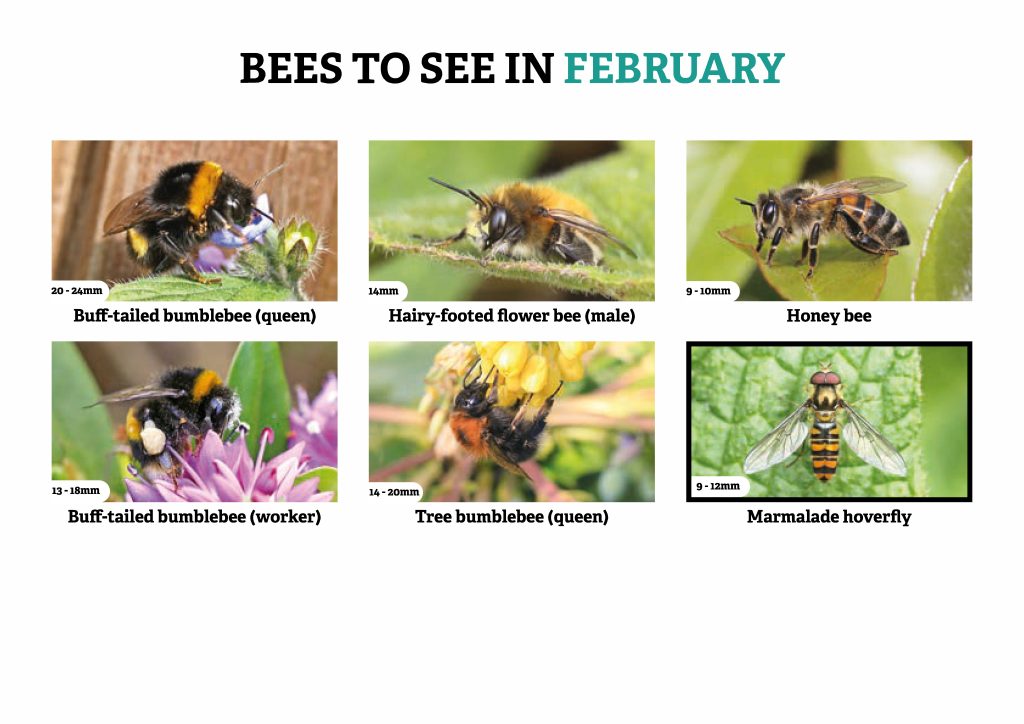
Tips for IDing February bees:
The arrival of the male Hairy-Footed Flower Bee by the end of the month is quite an event as he heralds the stirrings of spring. Although he’s a solitary bee, he is often mistaken for a bumblebee because of his cute, fluffy appearance. You will already see Buff-tailed Bumblebee queens and smaller workers foraging on hellebore, crocuses and mahonia. And in a few weeks, you may even glimpse a the more ginger-coloured Tree bumblebee queen foraging on early flowering fruit trees.
You may be wondering what the Marmalade hoverfly is doing in a bee ID guide. Well, this common hoverfly is an excellent honeybee mimic. Honeybees leave their hive on mild days to forage on early nectar and pollen and many novice bee spotters could confuse this hoverfly for a honeybee. By putting its photo along the bees you may see this month, I hope it will be easier to tell them apart.
How to ID
Buff-tailed Bumblebees (Bombus terrestris):-workers and queens
These plump, golden-striped bumblebees with a thick winter coat are the ones you’re most likely to see foraging now. If you live in an mild area of the UK where the Buff-tailed bumblebees are now acitve year-round, it is the workers of the winter-active colonies you will most likely see now foraging and collecting blobs of mahonia’s orange pollen in the baskets on their hind legs. (This winter activity was first recognised in the late 1990s when Buff-tailed bumblebee workers where observed in various sites. It’s believed that some summer queens set up nests in October – instead of hibernating until spring- and produced workers in November to take advantage of milder winters and the abundance of food provided by winter-flowering heathers, honeysuckles, and especially mahonia – a prickly shrub, widely planted in car parks and public green spaces, that produces copious amounts of nectar and pollen in winter.) If you live further north where Buff-tailed bumblebee colonies still die in winter, leaving only the queens to hibernate, it is these larger (up to 24mm) queens who you may see venturing out to forage this month. They will probably be flying close to the ground getting vital nectar and pollen from snowdrops, winter aconites and crocuses, and searching for a suitable nesting site, perhaps a used rodent hole, or a crack in a pavement. Although they are called Buff-tailed bumblebees, in reality only the queen has a clearly buff-coloured bottom, the workers and males have whiter bottoms.
Tree Bumblebee (Bombus Hypnorum) – queen
The queens can measure up to 20mm and are early flyers usually in March, but sometimes in late February. She has the same markings as her smaller workers and males (which you’ll see later in the spring/summer) – tawny thoraxes, black abdomens and white tails. These bees are particularly drawn to downward hanging bell-shaped flowers. At this time of the year that’s likely to be early comfrey and winter heathers.She also likes early blossoming fruit trees like Almond and Cjerry ‘Okame’ and willows. As well as foraging, the queen will be on a mission to find a nest. As their name suggests, holes in trees are traditional nesting sites. Alternative locations for nest sites includes the eaves of a building, loft insulation, compost heaps and bird boxes, so look out for her investigating walls, fences or blue tit bird boxes. Tree bumblebees have only been in the UK since 2001. They were first recorded in Wiltshire. They are thought to have come over from mainland Europe and have successfully spread right across the UK. Now they seem to be more abundant the further north you go in the British Isles.
Hairy-Footed Flower Bee (Anthophora plumipes) – male
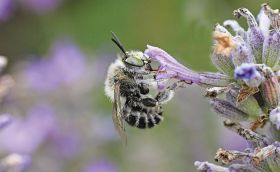
Male hairy-footed flower bees are the first solitary bee of the year to emerge. They display a distinctive hovering and darting flight, have a long proboscis (tongue) that is often outstretched, and buzz loudly making them easy to spot. You will often see a few of them chasing each other in a patch of lungwort or comfrey flowers from late February to April. But far from being friends, they are arch rivals patrolling a patch of flowers they want all to themselves to woo and mate with females (which appear next month).
Solitary bees nest alone, not in large colonies with a queen, workers and drones like bumblebees and honeybees. Despite their solitary nature, solitary bees often live next door to each other in large aggregations and hang out in big groups looking as if they are playing with their mates.
The 14mm brown-coloured Hairy-footed flower bee males come out a few weeks ahead of the slightly bigger velvety-black females. Their thick coats enable them to withstand the cold, but the males need to build up their energy by drinking lots of nectar from early-flowering tubular-shaped flowers. Their favourites are lungwort (Pulmonaria) , dead-nettles (Lamium album) and early flowering comfrey (Symphytum iberian). So plant these, or find a patch, and you will see the male Hairy-footed flower bees with their long proboscis outstretched ready to reach deep into the base of each flower for a nectar hit.
If you can find their nesting site, which are often in the mortar in between bricks in old walls that need repointing, or old cob walls, or even in crumbling fireplace walls, then you will see and hear the males darting noisily around, and in and out the holes hoping for a female to emerge. As old walls get repointed, or replaced by newer buildings, Hairy-footed flower bees lose their nest sites. You could try to make cob bricks where they may nest instead (see below).
What’s in a name? As for their delightful name, Hairy-footed flower bees do indeed have hind legs that are covered with feathery hairs right down to their tiny feet.
There are some 550 species of Flower Bees worldwide. The Genus Anthophora is made up of 2 Greek words – Anthos means flower and phora means to carry or bear, so flower bearing, which makes sense as they carry pollen and nectar from flowers. The species most common is the UK is plumipes – again 2 Greek works. Pluma is feather or plume, and pes is foot. So feather-footed. Apparently, the males use their feathery legs to caress the female during mating!!
We will meet other Flower bees later in the year, but they are much smaller and zippier, so harder to spot.
There are a few other solitary bee males that emerge this month but they are much scarcer so I’ve not included them in the Bees to See in February ID guide. However, if you’d like to know more, they include Clark’s Mining Bee (Andrena clarkella) and the Small Sallow Mining Bee (Andrena praecox) and Large Sallow Mining Bee (Andrena apicata). For more information read my blog here.
Honeybees (Apis millefera):
Managed honeybee colonies stay alive at this time of year by keeping warm in their hive and eating the honey they spent all summer making and storing for their winter food. On milder, sunny days or even cold, bright days when the sun has warmed up the hive, some worker bees will leave the colony to forage for winter-flowering shrubs nearby, or just to go to the toilet (they don’t do this in the hive). They are so much slimmer and smoother than bumblebees that there is little chance of confusing the two. But you could mistake them for the hoverfly below that mimics a honeybee.
Marmalade hoverfly (Episyrphus balteatus) – They are often seen hovering around flowers and will often be mistaken for wasps or bees as they are a similar size to a honeybee worker or a common wasp. But if you look closely they are quite different. They have much larger eyes than bees and their abdomen is dark yellow and has black stripes across it, with thinner stripes, that resemble a moustache, below them. But I find the two easiest ways to tell them apart from a bee, is 1) they have spindly legs and don’t collect pollen on them 2) a hoverfly will stay still on a flower or a leaf for much, much longer than a bee with its wings held out wide (as in the photo above), whereas bees tend to tuck their wings back and they never stay still for that long, otherwise I’d have much fewer blurry photos of them!
What is the point of hoverflies? Adult Marmalade hoverflies are good pollinators before they inadvertedly help to transport pollen between plants when they feed on flower’s nectar. They don’t collect the pollen because their larvae are carniverous. The larvae of this species help to control aphid populations. More details here
How to help bees in February:
- Plant a tree now, or sponsor a street tree. Next month it will be too late to plant a tree in the ground as they will no longer be dormant. Some trees are better for bees than others, because they produce more nectar and pollen, or they supply it early in the spring, or in late autumn when little else is flowering. What bees really need are trees that blossom sequentially producing a bee banquet throughout the year. Check our trees for bees guide. If you plant a Himalayan cherry (Prunus rufa) or a Tibetan cherry (Prunus serrula) you’ll not only have great blossom for bees in spring (as long as you plant single flowered varieties, not double-headed ones), but also fantastic rich coppery, peeling bark in the winter.
- Underplant your tree with rich-coloured hellebores whose large, bowl-shaped flowers are blooming now and Elephant’s ears (Bergenia) whose tall spikes will be visited by bees from next month.
- Lungwort (Pulmonaria), White dead-nettles (Lamium album) and Iberian comfrey (Symphytum ibericum), which can flower as early as March, will attract Hairy-footed flower bees to your garden. Plant in large clumps in sun, or semi-shade.
- Buy and plant bulbs ‘in the green’ You can buy bee-friendly bulbs now ‘in the green’, which means you plant them while the bulbs are in growth, rather than dormant (as they were in the autumn). Snowdrops, winter aconites and crocuses will feed bees now and grape hyacinths next month. English bluebells and small, yellow wild tulips (Tulipa sylvestris) will flower in April along with wild garlic and fritillaries.
- Plant early spring-flowering shrubs, such as Winter Daphne (Daphne odora) or Daphne bholua ‘Jacqueline Postill’ or Heathers (Erica carnea), which are perfect for a rockery or small flower bed with acidic, ericaceous soil. Winter flowering specimens, include white ‘Winter Snow’ (Erica carnea f. alba ), or ‘Winter rubin’ (Erica carnea ‘Winter Rubin’) for a splattering of pink. Although Rosemary usually flowers from April, with milder winters I’ve seen it flowering as early as January right through until summer. It’s also one of the most drought-tolerant plants I’ve come across and highly attractive to many different species of bee – mason, bumble, mining, and honey bees – so I’d recommend it to any bee-friendly gardener. See more shrubs here.
- As it gets nearer to spring there is the temptation to tidy up the garden so it will look neat when the crocuses and daffodils appear, but leave your garden unkept for as long as possible so as not to disturb bumblebee queens who could still be hibernating in piles of old leaves, long grasses or under a shed.
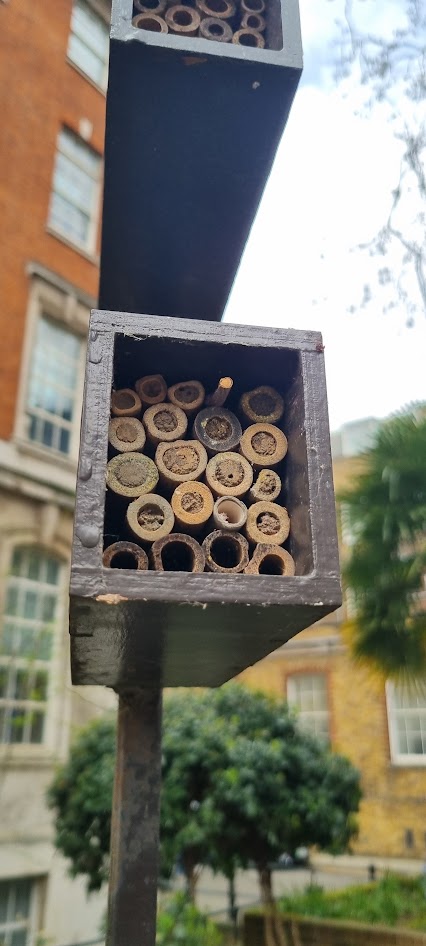
- It’s not too late to undertake bee hotel winter maintenance. Follow our simple step by step guide to care for these solitary bees over winter. Watch out for other insects hibernating in any empty tubes. I found queen wasps and spiders!
- You could try to build bricks of cob for the Hairy-Footed Flower Bee to nest in. Cob is an ancient material used for building walls and houses. It uses a mixture of clay, sand, cricket pitch loam, straw and water. There is a great video here by Devon-based naturalist, John Walter, on how to make cob bricks. They seem to need dry, warm weather to dry, or I suppose you could bring them inside to make them at this time of year. I’m going in search of cricket pitch loam! But the mistake I made last year was not protecting the cob bricks enough from the rain, so no Hairy-Footed Flower Bee nested in them. I addressed this the following year, but still not takers. Perhaps there are enough holes in brick walls around here. There are certainly lots of Hairy-footed flower bees.
- Submit sightings to iRecord of any bees you see this month.
- Submit Hairy-footed flower bee sightings to BWARS so it can update its distribution atlas.
Rescue a lifeless looking bee:
Offer a lethargic or exhausted looking bumblebee an emergency energy drink of sugary water. At this time of year they can get cold and tired very quickly after leaving the nest if they don’t quickly find nectar from a flower. A mixture of two tablespoons of white sugar to one tablespoon of water should revive them, but it may take them a while to find enough energy to suck up the liquid from the spoon or saucer you provide. Be patient.
An alternative is to pick her up and take her to a flowering bush, such as Mahonia, full of nectar-rich flowers if there is one nearby. But remember, bumblebees can sting if they feel threatened so pick her up on a leaf, or in a container.
Or invest in a Bee Revival kit which comes with a tiny refillable bottle attached to key ring containing an ambrosia® bee food syrup to feed a bee in an emergency.
Never feed a bee honey. Bacterial spores of a disease that affects bee larvae can be found in honey and this brood disease is highly contagious.
You can try the same remedy for a lifeless honeybee, but they may be more inclined to sting. Again DON’T FEED THEM HONEY.
I’ve never seen a listless Hairy-footed flower bee, but if you do I’m sure they’d also appreciate a water, sugar energy drink. These bees don’t sting.