
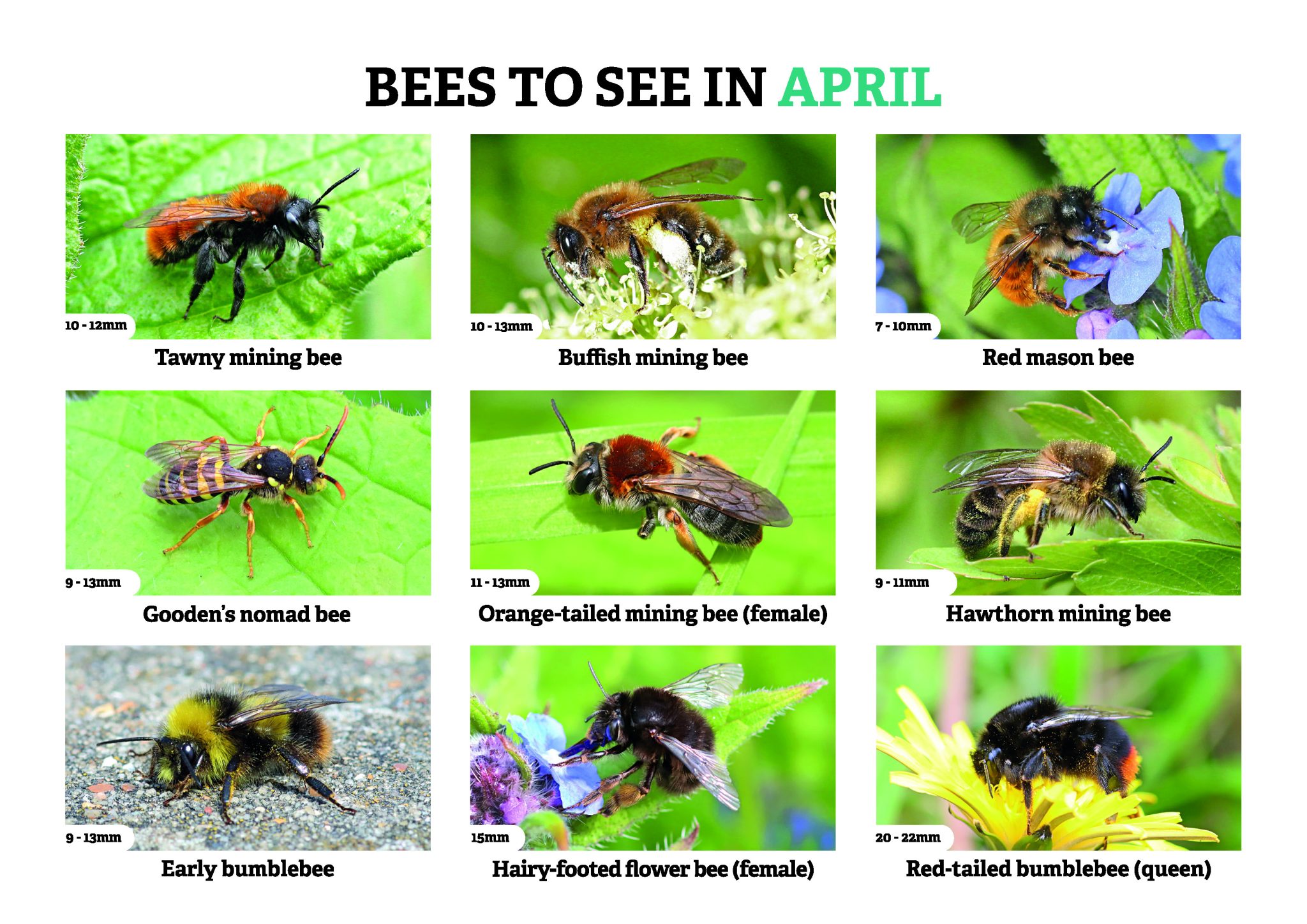

Pictured above are the six most common solitary bee species this month: , Tawny mining bee, Buffish mining bee, Red mason bee, Orange-tailed mining bee (female pictured), Gooden’s nomad, Hawthorn mining bee, and Hairy-footed flower bees (female pictured),
How to ID these solitary bees:
- The Tawny mining bee (Andrena fulva ) is easy to spot as she burrows up through lawns, her foxy-coloured coat strikingly visible against the green grass. And she leaves a tiny volcano-looking mound of soil in her wake. Like all mining bees, many will emerge from the same burrow or next door burrows in large aggregations.
- The Buffish mining bee (Andrena nigroaenea) is around 10mm -13mm with a dense brown pile on the top of its thorax (just below it’s head) a bit like a mane. Look at the flowers on blossoming trees and shrubs such as fruit trees, willows, and blackthorn, and wildflowers like dandelions, hawk’s-beards, buttercups and spurges.
- Red mason bees (Osmia bicornis) are checking out of bee hotels any day now by chewing through the mud-plugged tubes. They are a little smaller (7-10mm) than a honey bee (9-10mm), more gingery and have a rounder bottom. The males appear a week or so before the females and they congregate around the bee hotels waiting to pounce when the females emerge. The males sport a white moustache-like hair ontheir face, have long antennae and are slimmer than the females.
- Orange-tailed mining bee (Andrena haemorrhoa) males emerged last month and now the more striking, larger females (11-13mm) are emerging. They are easier to spot because of the neat brick-red pile on their thorax and the tiny orange tip on their bottom. Try looking for them foraging on fruit tree blossom, dandelions and spurge. They will fly until July so don’t give up if you don’t see them this month. Like all mining bees, they burrow into the ground to nest, and they collect pollen on the hairs on their hind legs.
- Gooden’s nomad bee (Nomada goodenianna) looks more like a common wasp, than a bee, It is actually a cleptoparasite, or cuckoo bee – meaning it doesn’t make it’s own nest, but as its name suggests roams around looking for the nest of its host, which is the Grey-patched (Andrena nitida) or Buffish mining bees(Andrena nigroaenea). As both these host bees can be difficult to ID becasue they are small, brown mining bees, look out for their nomad bee instead. If you see Gooden’s nomad bees, you can get a positive ID on their host. NOTE: There are 34 Nomada species in the UK (850 worldwide), and this is one of the most common. They break into the host’s underground burrows and lay their eggs. Their larvae kill the host larvae and eat the pollen. But healthy Nomad populations mean their hosts are alive and healthy. (Worldwide, a quarter of the 20,000 recorded bee species are cuckoos). TIP How do you to tell a Gooden’s and a wasp apart? Gooden’s are usually flying low looking for the nest of a mining bee or even walking around on the ground. And they won’t bother you.
- Hawthorn mining bee (Andrena chrysosceles) is another small (9-11mm), cute brown mining bee not easily distinguishable from many others! It has orangey coloured hind legs, a shiny blackish, striped abdomen and a brown, hairy thorax, Despite its common name, it feeds on a lot more than hawthorn blossom – dandelions, blackthorn, buttercups and spring-flowering shrubs.
- Hairy-footed flower bees (Anthophora plumipes) are often mistaken for bumblebees because of their round, fluffy appearance, but they live alone (not in colonies). At this time of year, the striking black females are being pursued by brown-coloured males among the lungwort (pulmonaria), comfrey, wallflowers and alkanet with their long, straw-like tongues (proboscis) outstretched. It is mating season.
TIP FOR IDING LITTLE BROWN BEES: If you see a bee that at first you may think is a honeybee, take a closer look. If it is a smaller. slimmer and browner, chances are it’s one of the many brown mining bees out at this time, of which the Buffish (Andrena nigroaenea) is one of the most common, along with Gwynne’s (Andrena bicolor) and the Short-fringed (Andrena dorsata) mining bee. Don’t worry if you can’t ID them, the fact that you are looking closely is good. The latter two have two generations in one season, so if you don’t spot them in the spring, you may see the next lot in late summer instead.
How to help solitary bees:
- Plant lungwort, wallflowers, comfrey and flowering currants for long-tongued Hairy footed flower bees. Flowering fruit trees, willows, spurges, wallflowers, Rosemary, alkanet and forget-me-nots for mining bees and Red mason bees.
- Leave old mortar untouched as Hairy-footed flower bees may be nesting here. Or make some cob bricks that they can nest in instead.
- Install bee-hotels in a warm location at least a metre off the ground, ideally facing south, or east, where Red mason bees can check-in and lay their eggs this month and next. We’ve made our own bee hotels that we fill with either 15cm deep cardboard tubes or bamboo. The cardboard tubes can be removed in the winter and put in a cool, dry shed to protect them from the elements and the bee hotel can be cleaned and new tubes installed.
- Leave a patch of loose, bare earth for mining bees to burrow and where Red mason bees can collect soil to plug their nests.
- Create a bank of sand or a mound of sand in a sunny spot for mining bees to nest in.
- Let dandelions and alkanet grow – they are very important early bee food. Research shows there is a hungry gap for bee in March-April, so these good sources of nectar and pollen are more vital than ever.
- Don’t mow the lawn – let dandelions grow.
Bumblebees
Pictured above are two bumblebee species you’re likely to see this month: Early and Red-tailed bumblebees. (In addition you may also see Buff-tailed bumblebees (Bombus terrestris) which have been flying all year in some southern parts of the UK, Common carder bees (Bombus pascuorum) which are just emerging, and Tree bumblebees (Bombus hypnorum).
How to ID these bumblebees:
- The Early bumblebee (Bombus pratorum) is smaller than other bumblebee species (up to 13mm) and prettier with her fluffy yellow collar and her noticeable orangey bottom. As her English name suggests, this is a spring specialist. Not only does the queen fly early in the year, but she creates her colony of workers and males earlier than most other bumblebee species. So this month, you may see female workers and even males. You can tell them apart because the males have much more yellow facial hair, like the one above.
- The huge, 22mm Red-tailed bumblebee (Bombus lapidarius) queens are one of our biggest bumblebees and without doubt one of the most striking with their black body and fiery red bottom. Although widespread, I’ve not seen one for a long time. The books say she is partial to blossom of sallow (willow) and prunus (cherries and plum) trees. Research by Bumblebee Conservation Trust, shows that there has been a marked decline in this bee species over the last decade.
Queen bumblebees may have nested (most underground in old rodent holes, under paving slabs, garden sheds, or even in compost bins) by now and laid their eggs, and some, like the Early bumblebee, may even have produced worker bees who are out collecting nectar and pollen to take home to their queen and her developing colony. Now is a crucial month to help them collect sufficient pollen to feed the larvae in the nest that will develop into new workers. We can help best by planting pollen-rich spring flowers.
How to help bumblebees:
- Leave a patch of the garden wild for nesting sites and don’t disturb a nesting site if you find one (it will only last until the end of the summer).
- Put up a blue tit box for Tree bumblebees to nest in after the chicks have fledged.
- Plant dead-nettles, clover, forget- me-nots, rosemary, wallflowers and more to provide food this month for the short-tongued and long-tongued bumblebees.
- Sow seeds inside now to create more flowers later in the summer. Sweet peas, sunflowers, cosmos and Anise hyssop are some of the easiest to grow. Try growing on a heated mat until the seeds germinate.
- Don’t mow the lawn (let clovers and dandelions flower) and ditch the weed killers and pesticides.
- It’s still cold in the mornings and when the sun goes in, so bumblebees can get chilled and easily exhausted. The best way to help is to put them on a flower, or give them a teaspoon of sugar, water solution, or carry a Bee Revival Kit on a keyring. But they can rest for 45 minutes. So give them time. But please don’t feed them honey, it harbours bacteria that is bad for them.
For information on the honey bee (Apis mellifera) and the bee-fly (Bombylius major) see Bees to See in March blog here.