Solitary Bees
Vital pollinators
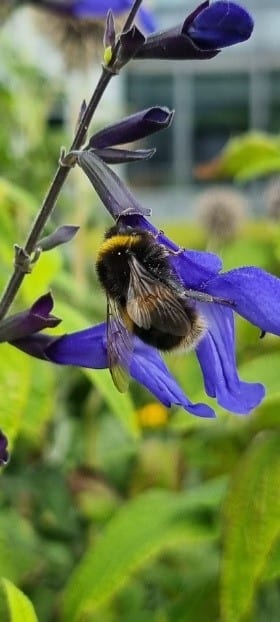
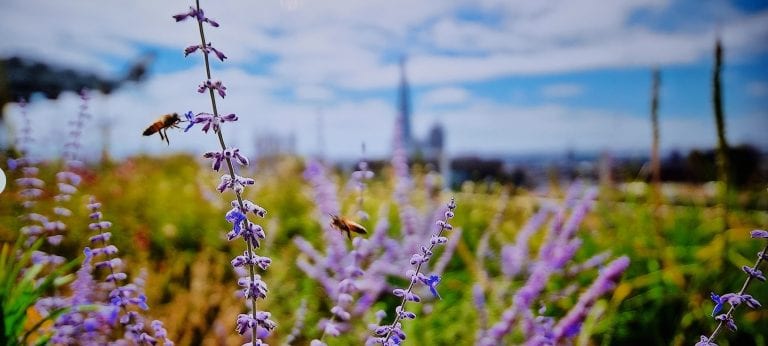
Of around 270 species of bee found in the UK, more than 200 are solitary bees. (Worldwide, the vast majority of the 20,000+ bee species have a solitary disposition.) They don't live in colonies with a queen, workers and drones, like honeybees and bumblebees. Instead each female makes her nest alone, though they often nest next door to each other.
These wild bees are docile and safe around children and pets.
Many of these bees don't conform to our image of a bee — striped, hairy, round and more than 10mm in size. Many are small and brown, and others even look black and shiny. And they don't make honey. But they are all covered in electrically-charged hairs which attract pollen. Some collect the pollen on their back legs, others on hairs under their abdomen, to take back to provision their nest. In the process bees pollinate 88% of all flowering plants on the planet.
Many solitary bee species have declined in the UK because of a lack of suitable habitat.
Cavity-nesting solitary bees
Some solitary bees make their nests in existing cavities in hollow stems, old bricks or in dead wood. We can help by creating manmade bee hotels — structures containing hollow tubes measuring 15cm long with diameters of 6–8mm, which attract:
- Red mason bee (Osmia bicornis)
- Blue mason bee (Osmia caerulescens)
- Leaf-cutter bees (Megachile centuncularis, M. willugbiella)
Tubes with a smaller diameter (2–5mm) may attract smaller solitary bees, including:
- Yellow-face bees (sp. Hylaeus)
- Small scissor bee (Chelostoma campanularum)
- Large-headed resin bee (Heriades truncorum)
Tubes with a larger diameter (8–10mm) may attract larger solitary bees, including:
- Orange-vented mason bee (Osmia leaiana)
- Wool carder bee (Anthidium manicatum)
Place bee hotels in a warm, sunny, south or east-facing spot, at least 1m above the ground. Many solitary bees may check into the same hotel, living side by side but alone in individual tubes. We know when a tube is occupied because the end is sealed.
Ideally, tubes will be made of cardboard or bamboo, contained in a wooden structure. Holes drilled into a piece of wood, the same length and width as the tubes, will serve the same purpose as a bee hotel.
What you will see
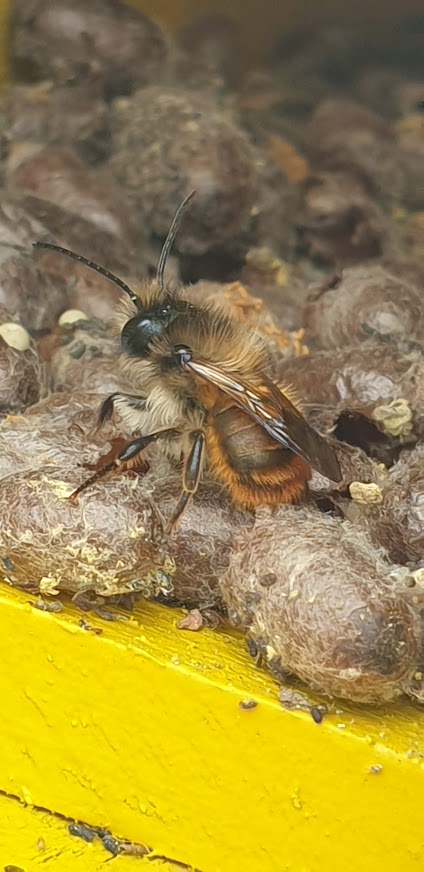
- Red mason bees (8–10mm) emerge in late March to April, sealing their nests with mud.
- Blue mason bees (7–9mm) have a black/blue sheen. They follow in late May to late July, using finely chewed leaves to complete their nests.
- Leafcutter bees (7–9mm) appear June to August, flying to the bee hotel carrying pieces of leaf nearly as big as themselves. Megachile centuncularis, the most common species, constructs cells from cut leaves glued together with saliva.
- Yellow-face bees (4.5–5mm) are tiny black bees with yellow markings on their face. They fly from May to September. They seal their nests with a saliva mixture that creates a cellophane-like membrane.
- Small scissor bees (4–4.5mm) are the smallest bee in the UK. Another black species, they fly from June to August and can be seen foraging, mating and sheltering inside the petals of bellflowers. They seal their nest with mud and tiny pebbles or pieces of grit.
- Large-headed resin bees (5–5.5mm) are small black bees with a large head, flying from June to September. They construct cells from pine resin and seal their nest with pieces of grit mixed with resin.
- Orange-vented mason bees (7–8mm) have orange hairs under their abdomen to collect pollen. They fly from early May to August, also using leaf mastic, like blue mason bees, to plug the tubes.
- Wool carder bees (8–10mm) are robust with yellow markings down each side of their abdomen that look like stitching. They fly from June to August, hovering and darting around a patch of lamb's ear plants: the males defend their territory waiting for females to mate with; the females collect pollen and fibres from the underside of the plant's fluffy leaves to line and plug their nest.
Life cycle
Once a solitary female bee has mated and chosen a few tubes for her nest, she lays a series of 7–8 eggs inside each of the tubes. She creates individual compartments for each egg, provisioning each with pollen to be eaten once the egg hatches into a larva. When she has laid all her eggs and provisioned each with pollen, she seals the tubes. This whole process takes around six weeks — the short life span of a bee. Inside the tubes, developing larvae eat the pollen, spin a cocoon, pupate, and metamorphose into adult bees. They spend the rest of summer and winter in the cell, waiting for the following spring to emerge, mate, and continue the cycle.
Forage
Solitary bees need good nutrition as well as suitable nesting sites. Try planting:
- Forget-me-not (Myosotis), hardy geraniums, wallflowers (Erysimum), green alkanet, Pieris japonica, and crab apples and apple blossom for red mason bees.
- Culinary herbs including rosemary, thyme, oregano, and horehound (Marrubium vulgare) for blue mason bees.
- Ornamental thistles, daisy-like flowers, sweet peas, bird's-foot trefoil (Lotus corniculatus), and St John's Wort (Hypericum) for leafcutter bees. They also like to cut discs from rose leaves and rosebay willowherb to build their cells.
- Fennel, angelica, wild carrot/Queen Anne's lace, weld, yarrow and common ragwort for yellow-face bees.
- Many different types of bellflower, also known as campanulas, for small scissor bees, whose Latin name (Chelostoma campanularum) is the clue to their favourite flower.
- Sneezeweed (Helenium species), common fleabane, common ragwort, and sunflowers for large-headed resin bees.
- Knapweeds, ornamental thistles, borage, hardy geraniums and bird's-foot trefoil for orange-vented mason bees.
- Lamb's ear (Stachys byzantina), woundwort (Stachys sylvatica), catmints and dead-nettles to feed wool carder bees. For nesting material, if lamb's ear isn't available they will collect fibres from other fuzzy-leaved plants such as mulleins (Verbascum), rose campion (Silene coronaria) or globe thistle (Echinops).
Over winter
By late September all is quiet at the bee hotel. The mother bees have died, leaving their offspring inside. These young bees wait until spring to emerge. During this time you can give the hotel a clean and check for parasites. You can even remove your bee hotel and overwinter it in a dry, cool shed — remember to put it out again in early spring with a new hotel full of clean tubes. On a warm spring day the bees will emerge and look for clean tubes to lay their eggs in.
Ground-nesting solitary bees
More than 80% of solitary bees are ground-nesting. They are often a type of mining bee or furrow bee that burrows into banks of sandy soil or bare patches of ground where they lay their eggs, provision them with pollen, and seal them.
We can help by creating sand mounds or banks for the bees to nest in. Here's how:
- Find a sunny, warm area of around 1m² and clear it of vegetation.
- Lay a base of gravel for good drainage.
- Bees prefer loamy soil, but if you don't have any, replicate it by mixing one bag of builder's sand with two bags of topsoil to get a consistency that binds together.
- Add the soil little by little on top of the gravel, layer by layer, patting it down as you go.
- Keep going until you have a mound about 400mm high.
- Add some large stones or pebbles to the base — bees may bask on them to warm up, shelter behind them on windy days, or make their holes in between them.
- Monitor to see if any holes are made and who may be nesting in your sand mound.
- Keep your sand mound free of vegetation.
The life cycle of ground-nesting bees is the same as cavity nesters. The more common ground-nesting bees fly between March and May. They include:
- Orange-tailed mining bee (Andrena haemorrhoa)
- Buffish mining bee (Andrena nigroaenea)
- Gwynne's mining bee (Andrena bicolor)
- Tawny mining bee (Andrena fulva)
- Yellow-legged mining bee (Andrena flavipes)
- Grey-patched mining bee (Andrena nitida)
- Short-fringed mining bee (Andrena dorsata)
- Ashy mining bee (Andrena cineraria)
They are all a brownish/orange colour, apart from the bright red-orange tawny mining bee and the black-and-white ashy mining bee. They vary in size from 7–14mm, but all have short tongues (proboscis), so they feed on open, spring flowers, blossoming fruit trees, willows and early-flowering shrubs. Dandelions and alkanet, often dismissed as weeds, are particular favourites.